


The movie Death in Venice, directed by Luchino Visconti and based on Thomas Mann's novel, is much more than a literary adaptation. It's a deeply visual work that turns the protagonist's psychological conflict into settings full of symbolism, beauty, and melancholy. Visconti builds a reflection on desire, the passage of time, decay, and death.
In the movie, Aschenbach is no longer a writer, as in the novel, but a composer. This change allows music to have a central role in the story, especially the compositions of Gustav Mahler, whose work constantly accompanies the character’s emotional deterioration.
Aschenbach appears as a refined, intellectual, and extremely disciplined man. He has dedicated his life to the pursuit of artistic beauty and to controlling his emotions. However, during his stay in Venice, he meets Tadzio, a Polish teenager whose idealized beauty awakens feelings in him that he had kept hidden for years.
From a psychological perspective, Tadzio functions as a projection of Aschenbach's repressed desires. He is not simply a person, but a symbol of youth, perfection, and vitality. The protagonist starts out gazing at him as if he were a living work of art, but that admiration gradually turns into obsession.
As the movie progresses, we see how the rational image Aschenbach had of himself begins to crumble. His need to stay close to Tadzio leads him to ignore obvious signs of danger, including the epidemic spreading through the town. Reason loses ground to desire, and the character becomes trapped in a fascination he can no longer control.
The set design is one of the most important elements of Death in Venice. Visconti turns every space into an extension of the characters' psychological conflicts. The Grand Hotel des Bains, where much of the action takes place, symbolizes the aristocratic and refined world that Aschenbach belongs to. Its spacious halls, elegant decoration, and carefully arranged spaces reflect the ideal of harmony and perfection that the protagonist has pursued all his life. On the other hand, the narrow streets, dark canals, and increasingly empty corners of Venice convey a sense of decay and sickness. As Aschenbach's obsession grows, the city becomes more suffocating and labyrinthine.
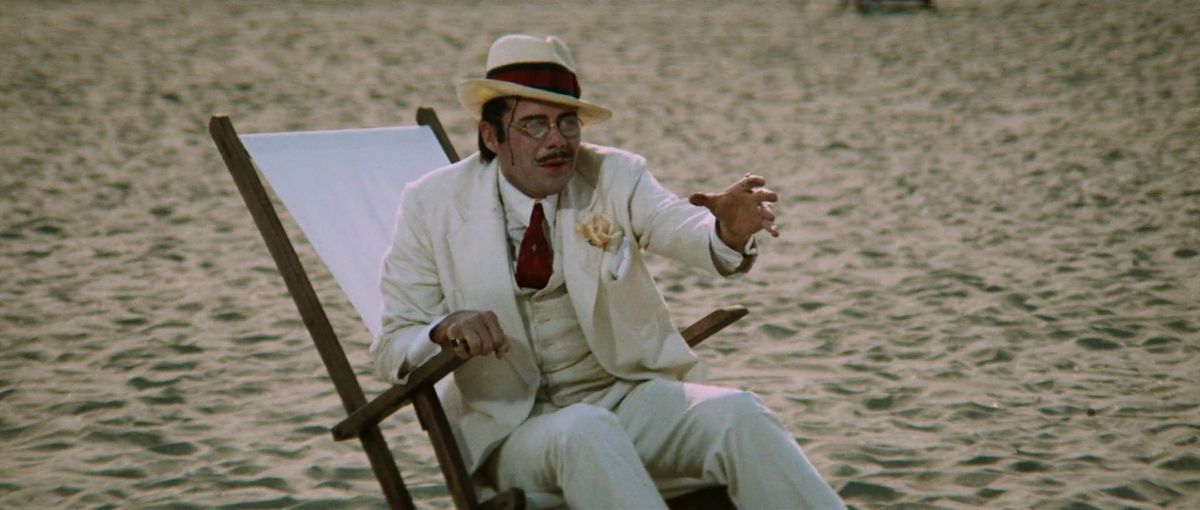
The color palette also plays a key role. Golden tones, bright whites, and the summer light create an almost dreamlike atmosphere. However, that beauty never feels completely reassuring; there’s always a sense of fragility, as if everything is about to disappear.
Visconti uses long silences, glances, and slow camera movements to tell the story. Many of Aschenbach’s emotions aren’t expressed through dialogue, but through the visual composition.
Tadzio’s shots are especially significant. He often appears lit by natural light, surrounded by the sea, or in open spaces that highlight his idealized character. The camera, in a way, takes on the protagonist’s point of view, allowing the viewer to understand how aesthetic fascination gradually turns into obsession.
Thomas Mann's original novel was born out of an experience the author himself had during a trip to Venice. There he noticed a young Polish aristocrat, whose image inspired the creation of Tadzio. Additionally, the city's atmosphere and fears related to cholera outbreaks helped shape the story.
Death in Venice is a movie that explores the relationship between beauty and disaster. Aschenbach's obsession with Tadzio reveals the cracks in a personality built solely on discipline and control. At the same time, the scenery, Venetian architecture, and extraordinary artistic direction turn the city into another character in the story.
The result is a contemplative and deeply symbolic work, where every image helps show the slow downfall of a man who realizes too late that absolute beauty can be as fascinating as it is devastating.
I could never call this work a romantic one, since it's not; it’s based on obsession, idealization, the pursuit of perfection, and repressed desires. Aschenbach never looks at Tadzio with eyes of love, but rather sees him as a piece of art, though you could say there’s a hint of romance, even if it’s only Aschenbach’s idealization.
10/10
Comments
Displaying 0 of 0 comments ( View all | Add Comment )