


Today while preparing some tomatoes for canning, a few yellowjacket workers came by get some sugars from the discarded tomato skins. Summer is now officially coming to an end when the social wasps begin their desperate searches for sugars.
The point of this blog entry, is to defend my friends the wasps - mainly the social wasps (paper wasps, yellowjackets, hornets - the wasp species that live in a social hierarchy and create paper nests). Nearly all wasps are solitary species that people barely pay any mind to or even acknowledge the existence of. Yet everyone knows who the social wasps are. Social wasps are probably some of the most maligned and misunderstood insects in the world. You are frequently met with the idiotic attitude of "bees are friends, wasps are assholes", or the whole "kill it with fire" trope.
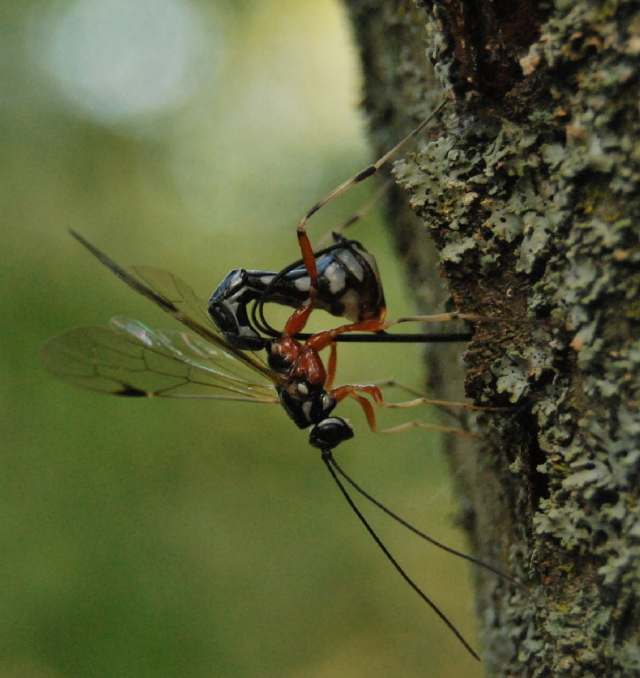
Solitary wasp species - Rhysella humida - ovipositing in wood - my own photo
The myth of "aggression" in social wasps. Wasps are not aggressive. Wasps are defensive. The utterly foolish idea that wasps seek out people just to sting them out of some spiteful rabid hatred for humans. No they don't, and you can piss off with your stories about "that one time" you got stung for no reason. I guarantee there was a reason. You came too close to the nest, you applied physical pressure to the wasp, the wasp accidentally flew onto you and panicked.
Why do social wasps get more irritating in the late summer? They're starving to death. In the spring, a foundress (let's use the term "foundress" instead of "queen". Queens are reserved for ants, termites and honeybees) emerges from her winter sleep (I'm using a North American bias here), and finds a location to start her nest. She lays eggs in the cells of the nest she creates, which emerge into workers. While the workers are in their larval stage, they secrete a sugary substance which feeds the foundress, and eventually, as the colony grows, the ensuing larvae feed their sisters and so on. But to feed the larvae, the workers must go out and hunt other insects, or find other meat sources. The workers then take the meat back to the larvae, who reward the workers with the sugar. Workers don't eat meat, they only eat liquid sugar.
So as the season comes to an end, and all of the larvae have flown off into adulthood, the wasps must now find sugars/nectar elsewhere; flowers like goldenrod. And to kill another myth made by fucking imbeciles "wasps don't pollinate". Wasps are pollinators, tremendously so. Then the flowers begin to shed their seeds and die as autumn comes into full force. The wasps have no more flowers, or very few flowers left for nectar feeding. The wasps are desperate and now resort to trying to get sugars from our barbecue picnics, fruits, soft drinks, beer, whatever we've got that has sugar.
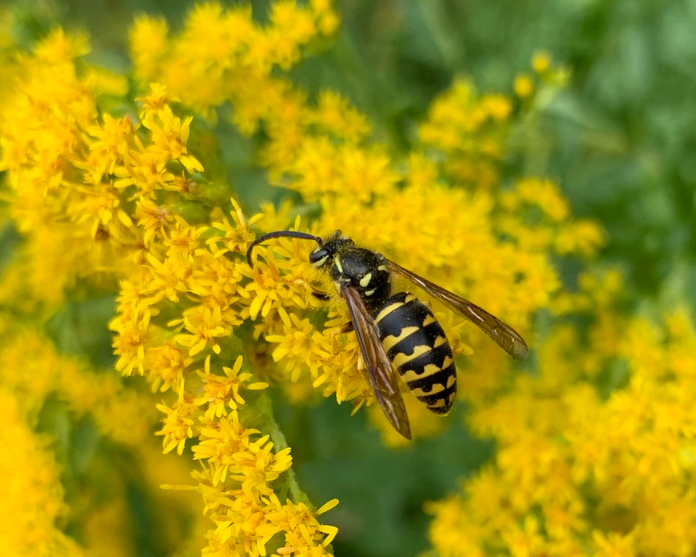
Common aerial yellowjacket on Canada goldenrod - my own photo
Thus ends my plea for understanding these animals, and the close to death situation they are in at this time of year in Northern North America. They've worked all summer providing for their sisters, controlling pests, and pollinating. Leave a little dish of sugar water out for them, especially once the flowers wilt and fade.
I fucking had to.
Comments
Displaying 0 of 0 comments ( View all | Add Comment )