



Part 2 of my review transfer.
Joker 2 Review
RATING: 1.5/5
REVIEW:
TLDR: what if the joker was called the freaky and he had SEX with HARLEY QUINN!!
This movie was NOT very good, but I wanna start with what I recognized from it, and what I think it was trying to do.
The movie centers around the court case for the joker following the first joker movie, the primary defense is trying to get him off with a plea of insanity based around the idea that he had split personality disorder and that the "joker" is a separate entity within his head and so the actual person Arthur fleck cant be charged.
There are a lot of people who support the "joker" who end up at this trial, people want to free him based on the idea that he is 'freeing" society.
The movies premise is trying to get the audience to guess if the joker and Arthur fleck really are the same person or not. To support this, there are many places in the movie where the joker starts singing, these scenes are supposed to indicate to the audience that Arthur is having a "joker" moment. and we have to guess if he is just playing into the support he is getting from the public (trying to bask in his own public image) or if he is really splitting.
This whole idea of the "joker" being a separate entity is also the main plot point between harley Quinn and the joker. Harley, in this movie, is a sociopathic women who only wants to get with the joker, she cares very little for Arthur fleck, and so we have our sides. We have Harley pushing for Joker, the defense pushing for Arthur Fleck, and Arthur himself who cannot decide between the two.
SPOILERS FOR THE END OF THE MOVIE!! At the end, Arthur reveals that there is no joker, he gives up the fantasy and turns to reality after being molested in the bathroom at Arkham asylum. This doesn't answer if there NEVER was a joker, but it is saying that the joker is dead. The court room then blows up from a car bomb, supposedly set up by Harley or someone from the crowds outside, and Arthur escapes and goes to the stairs from the first movie where he finds Harley, who tells him that now that the fantasy is dead, there is no Harley and Joker. After that, Harley walks away and Arthur goes back to prison. The next day he is told he has a visitor, but while walking to the visitor room, he is stabbed by one of the inmates who loved "the joker" and Arthur dies.
So if I got what the movie was trying to do, why didn't I like it? Well first off there are so many fucking jump cuts its hard to even tell whats happening, I actually think that shots that last more than 5 seconds are rare. 2ndly, while the cutting to the musicals to indicate a split is an interesting concept, it isn't done very well. Especially when they cut to a whole new set with harley and joker on a stage, intended to represent the court room as they see it "a stage", but they serve very little narrative purpose outside of giving gaga more singing time. 3rdly, who the fuck IS this harley person, she is introduced so fucking quickly its insane, she seems to have access to literally anywhere plot relevant, why? how does she get into solitary confinement (implied she gave head to a guard I think, not positive), how did she get away with large scale arson within Arkham???? it just doesn't make a lot of sense. Why is there the subplot of a baby, just to get joker more attached to her? She is an unfocused character, despite the plots insistence that she is "supposed to be an enigma" (most of what comes out of her mouth are lies) she just comes off as unfocused, mostly like the rest of this plot! the movie could have easily shaved off 20 minutes, and probably been better off for it, simply because some shots serve little reason.
On the good side, there are some really pretty shots during the film, the movie *looks* nice, at the very least.
Dune Review
Hello! This is my review of Frank Herbert's 1965 Scifi masterpiece "Dune" I'll do a brief overview of the plot (spoiler free) then a ramble about my thoughts. Hope you enjoy!
Dune is set in some far off future of humanity, where mankind has not only conquered themselves, but also the galaxy, maybe even the universe. yet of all the planets under the imperium's control, none are more valuable than the spice world Arrakis. Here is where the spice is mined, the most valuable resource in the universe. Paul Atreides, son of the Duke Leto Atreides, and his mother Jessica, a bene gesserit witch, are one of the 12 royal families under the parashah emperor of mankind. One day, the Atreides house is given control of Arrakis by the emperor. While settling into the new world, they are betrayed by another household, the Harkonnens. Leto is killed, and Paul and his mother flee into the desert, seeking help from the locals of the planet, the fremen to one day take Arrakis back... all the while, Paul may be more than he appears.
Overall review: 4.7/5
From here on out there will be mild to serious spoilers for dune, so read at your digression. Its gonna be a bit ramble-y as well haha, but I'll break it up into four sections: world building, the characters, the plot, and a short section on the impact of dune.
WORLD BUILDING:
The worldbuilding in dune is some of the best I have ever seen, and that is truly saying something, this is for a myrriad of reasons, but one of the biggest ones is the lack of exposition. Exposition in stories is often necessary to produce a world that feels real. It can help establish locations, history, etc. Dune has almost no exposition, the entire world is slowly unfurled to the reader through dialogue and and internal thoughts. I cannot think of a single time in the story where the plot was paused for a character to think "Ah yes, this is a spaceship, designed by the spacers guild who were founded in 19743 AD of the imperial calendar and are a secretive guild of space faring pilots" no! instead, these facts are doled out slowly and naturally. This creates two great effects. One, the world feels truly real, characters aren't stopping conversations to throw facts that should be common knowledge out. two, the world isn't overwhelming, we get exposed to this universe slowly, and so all of its intricacies are actually quite digestible instead of being unapproachable or hard to remember. Best of all, the world building isn't just good, the world itself is also very colorful and fun. I really enjoy that some things are kept mysterious, Paul wouldn't know of the ins and outs of the spacers guild, so neither do we (well, maybe he might at the end). The blanks actually let the world be more believable instead of less, sometimes over explaining a concept creates more holes than it patches.. (looking at you harry potter). What we do know of the universe is, naturally, centered around Arrakis, I love the deep look at the Fremen, their religion, politics, culture, etc, which was seeded by the Bene Gesserit, and then became more from those very same teachings. The Muad'dib being half legend half science is really interesting. It truly plays the line between fantasy and scifi really well. I liked the world building so much that I actually read the only exposition found in the book, that being the appendix! Learning about the terminology of Dune after reading it really helped actually fill in some interesting blanks, stuff that isnt explained in the books, doesn't really have to be, but also is interesting in retrospect once you know it is super neat. It reminds me of Tolkien's work. I think the only part of this that I wish we heard more about is aliens, do they exist? clearly alien fauna does (the sand worms make that clear) but what about intelligent life. They hint at it maybe the humanity has conquered it already, but I wish they would state if it existed or not. There is plenty more I could say about the world building and how interesting it is, but basically it would boil down to: read the book!
CHARECTERS:
I probably have less to say about the characters than I do the world building, I really did like them, but the book is less interested in the characters than it is about the overall story it is telling, which is a good thing! That doesn't mean that the characters lack personality though. Similar to the world building, aside from physical appearances, there is very little exposition about what a character is like. No "this is jessica, she is strong and mighty" or "This is the noble and fierce duke Leto" the characters are personified simply from their interactions with the world. We learn that Leto is a strongly convicted man who wants the best for his family and people not because it is told to us, but because his actions reflect those traits. A similar story could be told for everyone in the book. I particularly like the characterization of the Bene Gesserit, the way they act, and their little chants and micro controlling over their own body makes them extremely interesting characters, it was always neat to see Jessica remove the fear from her body, it made events where she could not all the more nail biting. Paul himself changes over the story immensely, once his prophet powers awaken, he starts as a boy, a well trained and strong willed boy, but still a boy, but grows into a capable leader of the Fremen and more than that leader over his powers. I do wish we had seen more of that growth ourselves though, the 3 timeskips that happen during the book robs us of some of those moments of growth I think. Chani I also wish was given more time to be established, though when I say that, I'm not sure when that time would have come from, I think I just liked Chani as a character and wish we saw more of her, as she sort of became a background element. Although, the background-elementification of characters is a plot point within the story as Paul himself says "I have made worshippers from friends" as he becomes more the prophet of legend. Vladimere Von Harkonnen is so delightfully unlikable, most of the Harkonnens are, but him in particular. he is Gluttonous, violent, deceitful, scheming, I say this with true respect when I say it is a JOY to dislike him. All this to say the characters are great in dune.
PLOT:
With such fantastic world building and characters it should be no surprise when I say the story of this book is something epic. I almost don't really have a lot to say other than it's great! there is so much to love, I will admit I liked part 1 the most. I really liked the layered plot of the Atredies wondering who their betrayer was to be (damn you yueh.) but all 3 parts are great. The timeskips can also be a little bit jarring, as they aren't separated particularly well from the rest of the plot, and so I did have to go back and re read about 3 pages one when I realized I didn't understand where we were. These are minor nitpicks however, and generally I really enjoyed the story, its long but there were so many times I couldn't help but read one more damn page....... so epic... The move from hyper characters focus to more of a pulled -back overview style of writing is done very naturally, you might not even notice it by the end of the book! The final battle starts and ends in a flash, which is appropriately climactic. so yeah! overall just a fantastic story, not a lot of personal notes about it. There are a few deeper topics that I fail to mention here, but primarily the one I picked up on is criticism of religious dogma and how religion by mankind is and always will be flawed by design "there is nothing simple about religion" "it is a medium of unity" was a good line in the book for a reason, Dune stats somewhat that religion is not only flawed but also the rules of religion are a farce, we can never scribe gods word without the hubris of man, There are a few others centered around ecology and whatnot, but that may be the biggest one I picked up on.
The IMPACT of dune:
Dune is sometimes called the grandfather of modern scifi, and it isn't hard to see why. Some of you may know I'm pretty into warhammer 40k, and the sheer amount that warhammer takes from dune is staggering. I won't go into it here simply because I could write another few pages on the matter, but its impact is enormous. Even other things, like Red Rising, which I read recently (you can check out the comparatively shorter review from my page) take inspiration by way of the "blue" caste of hyper calculating human space pilots, or the scarab shields of energy that sit close on the body. Anywhere you look in modern scifi, you will see aspects of Dune.
Thanks all, I know this review is VERYYY long, but hopefully it gave a good insight on my thoughts. Next up is Crime and Punishment, and I'm also picking up the Red Rising series once more to read the next 3 books.
Blue Chip Kids review
Written by David Bianchi
Final score: 3/5
Blue chip kids is a book about economic terminology, it is far from in depth and really only talks about surface level economic policy, but its a great read if you're new to stocks (like me) or just want to know what people are saying when reading a news article about the economy.
some sections are more useful than others, for me, the most important/valuable section was that on the stock market, I finally understand "option" trading is, what shorting a stock is, etc, which was actually useful as I do intend to enter the stock market at some point!
The illustrations are cute, though not super helpful, and offer something to look at which I like! they were done by the authors kid, or maybe his kid's friend? something like that.
The language is shockingly easy to understand, this I will say, it doesnt matter how dense you are to this kind of thing (me in particular being a dumbass to money terms) it breaks it down in to hyper simple terms, perhaps too simple sometimes, but regardless very understandable.
Regardless of whether you intend to be involved with the economy or not, I'd recommend picking this or some similar book up just to learn and know whats up.
Silent Hill 3 Review
Hello! I just finished konami's silent hill 3, usually I let a game or book stew for a bit before hopping on to write a review but this game is so epic I cant help but start writing it now. To be honest I have so much to say about the game that it's almost daunting to try to write this, but lets do it anyway.
Firstly I wanna say I played the PC port of silent hill 3, I know nothing about the silent hill franchise as of right now and I haven't looked up anything related to it's story, so everything I'll say here is purely my thoughts and interpretations while playing the game. I played the game on normal mode. the game took me 7 hours and 48 minutes.
Overall ranking: 3.5/5
General spoiler free thoughts up first:
In this game you follow heather, our protagonist, as she is thrust between our world and a mysterious other world, plagued by monsters, while trying to get home. Throughout the game you will solve the mystery of your past, fight monsters, and get immersed in an incredibly atmospheric adventure through our own psyche.
This game was really cool, the atmosphere, sound track, design, everything had me hooked from the second I started playing. (special mention to you're not here which is one of my new favorite songs). Though the gameplay is fine, the game is so atmospherically perfect its probably in my top 5 games. I love the otherworld's general vibe but most specifically, the game feels perpetually creepy, you are afraid, yes not petrified, which I feel mirrors heathers feelings The puzzles are kind of lame, they're fine, but they are mainly just there to cause you to explore the maps. I never really got any good at the combat, and so that generally was a low point for me (fuck you crawley guys) I never really understood when to hit enemies and when not too, I found myself always low on ammo, and would mostly run past all the enemies I saw. I'll talk a little more about that later. The walking was appropriately janky tank controls, and it made the game a lot more stressful. I think thats a good way to put it really, the game isn't very scary, its creepy and stressful (in a good way) it keeps you alert while not putting you off to the game, so I'd give it a try even if horror games aren't generally your thing. I swear this game has no jumpscares, so you dont have to worry about that (seriously, no joke, no jumpscares). The story is confusing, as I expected it to be, but you seemingly dont have to have played the 1st or 2nd game to understand it, though I'm sure it exemplifies the experience. I like the games themes of religious criticism (seems like a trend on this blog), and some other themes I'll talk about in the spoiler section.
Beware spoilers from this point out:
Atmosphere/design:
as previously mentioned the game has an insane atmosphere, the textures are so solid, the draw distance appropriately slim. The monsters are horrifying, the oppressive atmosphere of the rusted, bloodied, ruined otherworld mirror perfectly with the darkness of the real world, neither one was safe, you never felt "in the clear" completely. Speaking on in the clear, the Radio: what a small detail that made an insane difference to the game, you always know when a monster is nearby, you always know when you're in direct danger, and yet so often you cant even see the threat immediately, the camera angles forcing you to look around wildly to see the threat (again, no actual jumpscares, which I highly appreciated as I tend to be turned off from games with them). the flashlight is another piece of gear that really changes the game. While the light doesn't reveal a whole or increase your view range, there are some particularly dark parts of the game where you should use it. other than that it does very little other than make you feel more confident. I think my favorite level for atmosphere was probably the Subway -> office building levels, Though the subway level wasn't particularly great gameplay wise, other than the train section. The chapel is of course, insane, the final bossfight in between that womb of spikes was one of the most unnerving sights in the game. The weakest section for looks is probably the amusement park, I didn't feel particularly attached to the location (except for the very beginning) and the weird hanging bodies in boxes as blockades weren't super interesting. Al this to say the game looks absolutely incredible. There are a few "oh come on" moments in the game, a great example being the tiny bunch of boxes and the van "blocking" your path out of the alley at the start of the game, or not calling the cops after the monster showed up. Though in this case, its not like escaping the mall early would have changed much about the game, as heather was being hunted. Anyway, that part is probably for the story section. The design of the monsters is so crazy, again, creepy, scary, not terrifying, they arent so grotesque that they set you off from the game, but they are appropriately scary. I noticed a trend of a lack of faces on the monsters. While I wasn't sure on the thematic value of this detail, maybe to strip them of their humanity? fallen from gods grace and thus erased? I dont know, but they are appropriately hellish. Claudias design was the lamest for me, I wish she had a cooler outfit, but thats a very minor nitpick. The soundtrack is incredible, and I liked it so much I burned it to a CD (I'll show that off tomorrow) and I've listened to the whole thing probably 3 times over already. I can of course point to you're not here being a highlight, but end of a small paradise was another notable mention. it also somewhat reminds me of old point and click horror games in a way, but I dont know how to elaborate any further than that.
Another edit, perhaps I did not stress this enough, the soundtrack for this game is absolutely incredible, and I have listened to it on its own several times.
Edit: I forgot to mention this initially, but going to the town of silent hill? very cool, I wish it wasn't JUST for the hospital, would have made for a good non-liniar section.
Plot/Thematic/characters:
The story of this game is convoluted, there are some points that are easy to grasp, but theres a lot under the hood that I'm sure I missed. Though I dont think I missed any story elements, I explored every room, connecting the dots can be tough. Here I will put a summary of the story as I understand it, so as I give my opinions you'll understand where I'm coming from:
In the beginning there was a women who was cursed to birth to the girl who would birth god, she gave birth to a girl, and this becomes the child of Heathers dad, alissia, then that child dies in flames (presumably to prevent god from being born) but hands Heather to her dad, The dad raises heather, loves her, but is always resentful of them somewhat that she was partially responsible for alissia's death. the witch / friend sister of alissia goes hunting for Heather, and her and her dad flee away from silent hill. Heather, who is actually the reincarnation of alissia, is now the one who must birth god. Claudia knows this and wants to find heather to bring her back into the cult of the sun so that she will birth god prematurely as she thinks this will bring about judgement day and eternal paradise. She hires Detective Douglas to track heather down. As we traverse through the game, we learn that it is unlikely God that is forming the otherworld, but actually some sort of twisted, hateful god, and that the otherworld is actually a conjuration of Claudia's internal nightmare realm. We meet Victor, who primarily acts as brother to Claudia and is subtilty helping you throughout the game so that you can end the nightmare before God is born and prevent all of humanity from being wiped out and the nightmare realm from taking over the globe. Finally after killing god, Heather spares Douglas or kills him (this is the one part I looked up, the other ending of the game), indicating that heather has either ended the curse and removed the hatred from her heart, or succumbed to it and been possessed by god. It is unclear how much of the game occurs in heathers mind, versus reality (how could there be a building under the sewer under the.. complex thing? that then on its bottom floor leads to the street).
The story is told more like a play, the dialogue/ characters don't act very realistically, and instead move to push the story along (no time for cowering when we have a story to tell). to the point where I wish the characters did act a little more realistically. but yeah, the dialogue reads as if you were seeing a play, somewhat stilted dialogue, etc. Victor is written especially fancily. Other stuff, like monsters not being able to follow you between rooms is also indicative of this "play" style story telling, each room is a new set. it works, for sure, and its cohesive, even if its not my exact cup of tea when it comes to games.
I think the happpy birthday stuff has to do with the fact that its allisa's 31'st birthday, while its heathers whatever birthday, just a subnote.
Now that you know the story as I understand it, lets talk about themes. There are a few notable ones I want to talk about: themes of rape/ sexual assault. theme of criticizing religion/ themes of hubris and hatred
Themes of Hubris/ Hatred:
This one is probably the most surface level, the blood on heathers vest tells us when hatred has taken over her heart (over the death of her dad), it also marks the point of no return, now that god was being incubated in hatred, she would be born. Whereas before this, she may have never incubated at all. The hubris of Claudia to try to summon god despite constantly talking about her subservience to god is a great example, she cant even understand how contractive she's being, and victor tells her as much at the end of the game. Hatred vs hubris I guess. I like the self fulfilling prophecy these flaws introduce.
Rape/ sexual assault:
I'm not entirely sure about this, but I think the game is a big allegory for these topics, obviously sort of talking about the virgin mary with heather here. But yeah, the horrors of sexual assault may indicate the rejection of pregnancy, the biological horrors, impact of family, etc. I think this is the darkest part of this game, and also contributes to the "all in the head" stuff. but yeah, I dont have a huge amount more to say about this. a forced pregnancy and forced to give birth into a nightmare you dont want, seeing the baby as demonic, I hope that's making sense. Coming out the other end, maybe of an abortion? and then returning to your original name feels symbolic here too. A very serious theme, that I think is done really well, if I'm interpreting it right.
Themes of religious criticism:
this game is rife with religious criticism, as it talks about the hubris of man to think they know the word of god. it talks about how fanaticism is dangerous and leads to delusional people, it talks about how evangelicals, by wishing for the doomsday to come to bring them to heaven, are also asking all others to be cast to hell (hatred) and I'm sure plenty of other things. Basically I think its saying that paradise cannot be risen out of hatred, and that hatred also takes the form of not wishing to condemn anyone. I really like this read, I've talked about my own general distaste for organized religion and I stick to that belief that organized religion is harmful. though this game really only speaks of fanatism as being harmful. (binding of issac reference).
Characters:
Our characters were interesting for sure, heather changes a lot over the story, and while I have gripes about the dialogue, she does grow and change, and certainly she acts scared at first, then later not. I got attached to her! Douglas is a weird space where he doesnt play directly into the story really, he just acts to push the story along for Heather, getting her to silent hill, finding heather for Claudia, etc. Claudia has the most interesting motives I think. Victor is neat cause he is a diest, idk. again, they all act like play characters, they aren't really distinguishable from the plot, they dont exist outside of the story.
Gameplay:
The actual gameplay of the game is its weakest part, combat I remain to say feels awkward/ unfun to engage in, which would be fine if it was always a last resort, but instead it often was required to get through rooms. Movement (fuck that room with the red light) is fine I guess, again, its clunky, but also makes things more unnerving, if it was like.. half life controls I'm sure I'd have problems with it too. it felt intentional at the very least. Monster placement was all over the place, and I didn't really understand it most of the time, there were some rooms/ levels that were pretty easy to run right through, and then there would be a level where it has chill and spams you with tanky crawling enemies that cram 3 into a small hallway. the hospital level was especially guilty of this. Because of the clunky controls, the boss battles had to be pretty bare bones, but fuck the missionary boss, that guy was a pain to fight, overall they were sort of mid. I did have to use a walkthrough in a couple of areas, as the game is wayy harder without maps, and sometimes I would miss where the map was. But I tried to keep walkthroughs to a minimum, only when I was lost/didnt have ANY ideas what to do next, and these walkthroughs were purely gameplay, no spoilers on story. the puzzles are super weak, mostly just obstacles to get you to explore rooms, which is fine. I would almost call this game a super spicy walking simulator with combat themes. overall though, I liked it, where it felt intentional, it felt good.
Final thoughts:
this is a game held up by its story and atmosphere, but that story and atmosphere are so fucking good that it hardly needs anything else that it can make the somewhat lackluster enemy placement and combat bearable. very cool, may even play the other silent hill games.. maybe...
Plato's The Republic
Plato's republic is considered to be the cornerstone of western philosophy, and by all accounts, this seems true. However, does that make it a quality read? nnnnot really. Lets talk about it.
Final rating: 2.5/5
(based on reading enjoyment, not the value of the book)
First I want to say that I read most closely the first book, that about justice and morals, as suggested by a friend to be the most relevant. While I did read the rest, it is not nearly as pertinent to society today. But lets break down what the book is about first.
Plato's the Republic is written as a dialogue between Socrates and some "friends" or other minds. In either case that has Socrates debating others on justice, morality (book 1) and the societal structure of Plato's version of utopia (books 2 onward). In this book, Plato is writing all characters dialogue, so it ends up being a little silly as its really just Plato arguing with himself and winning every argument (shocker). There is a prologue to the book that runs about 30 to 35 pages which is essentially an essay that details what Plato thinks throughout the book, you can honestly get away with JUST reading this prologue if you don't really care about how Plato gets to his thoughts, and rather just what they are. It even details most of his perfect society, which is neat.
One of the things I like most about the prelude is actually the background it gives on Plato himself. The book notes how, because this is from the perspective of someone from ancient Greece, many of the things Plato writes about cannot be 1:1 translated to today. (both in lesson and in lexicon). We, in the modern day, probably don't consider morality and justice to be the same concept, but it seems like this was the common ground during Plato's day. I found this pretty cool!
Lets talk about the book itself.
Book 1, on morality:
This book is mostly about proving that justice, and by some tie morality, is either implicit to humanity, or that humans should do good (and will be rewarded for doing good) even in a vacuum. There are several counter arguments put forth but of most notability is Thachimysus's (or something similar to that name) counter argument that Justice or morality is really just the strong imposing its will on the weak. This topic is sort of dodged by stating that unjust (or immoral) men will not work together, and thus cannot accomplish anything. I tend to disagree with him throughout much of the book, and this is one of those cases. I think arguing for an objective morality means you have to be able to define morality. Plato even writes that he is sad that he fails to do this, he cannot define justice in a succinct way, but rather just thinks that it exists even without societal input. My own thoughts? I think that, like the final argument in book 1, morality exists as a compromise between the unjust and the just (not exactly its argument, the final argument is more like all men are unjust, but the pain of being harmed is not worth the ability to harm, and therefore morality is a compromise, but I'm coopting it) to create a system of rules that benefit the many.
While many of the lessons contained within book 1 are better represented with someone with a little more academic background in this sort of thing, I'll do my best to represent my thoughts, though keep in mind one of the things that I find fun about these reviews is how little I reference outside material when possible, so I will continue that trend even here (even if its a little damaging to the review haha). Plato's moral ideas is one that I have obviously been faced with, with or without reading The Republic "is morality inherent to humanity, or is it a social construct." And while this isn't the first time I've thought about it, I am re-looking at it now:
As I said before I think it's a little bit of both, but I will expand on that thought here. I think my best stance on the subject would be as a "biological moralist" (if that isn't a real term, I'm coining it here and now). I believe that morality can be split into two categories, "higher" morality, and "lower" morality. Lower morality is that which makes up the basis of society, do not kill people, try to be "kind", try to prevent death, etc. These rules are biologically tied to our altruistic social structure (altruistic here as a biological term, not a philosophical one.) These rules generally only apply intrinsically to our in group, those who are directly around is, and generally does not apply as automatically to those in your "out" group or those you do not have direct ties too. I do want to make it clear that empathy is of course possible for an out group. I just mean it is not as automatic or at the very least it is not tied to "lower" morality. Summarizing here: lower morality is biologically tied to our evolution as pack animals, we thrived by helping our in group and aggressing the out group, and many of these ideas are still wired in our brain. When Glaucon states that all men wish to be unjust, but the harm of hurting each other is not worth the risk of being harmed, I think he means to be speaking of this in group out group dynamic. Lower morality, similarly, doesn't actually have to be tied to how heinous we consider a crime, only what rules we might follow in the absence of society. When I hear Glaucon is talking about "undo harm" I consider this to be (in my terms) him talking about when only lower morality is present, and the out group is large. AKA: when your in group is just your immediate locals, and the out group all others. and I think it is what holds a larger society together. This is a set of rules we have put forth to protect various out groups from each other, and is often (though not always) enforced by law (murder of someone in an out group, is an easy one to point too). In this way I think law, higher morality, and justice, are tied together. They are a triumverent of rules we have invented to prevent various smaller and dissimilar in groups from acting unfavorably or uncooperatively. Again, this is obviously not to say that you or I, if given the opportunity, would kill. But I would bet there is a higher percentage that would than under normal circumstances. Higher morality breaks down further as we delve into more and more dire circumstances. Similar to nature, the in group shrinks and the out group gets bigger as resources get more scarce. at it's lowest, much of a higher morality will be completely abandoned by general "masses" and lower morality will reign.
This is my best attempt at explaining my views on morality. I am sure it will be a little messy to read but hopefully it's somewhat understandable.
From the few other platonic literature sections I have seen, Plato likes to make his arguments in a few stages. Firstly he will write his "opponent" to tell him their argument, typically this is a good paragraph, next Plato (as Socrates, in this case) will begin to ask seemingly disconnected statements, asking if his opponent agrees with each one, before finally in part 3 he connects these statements into his "actual" counter argument. One of the things I really struggled with is just understanding the arguments at all, Plato is writing, of course, by the societal standards of ancient Greece. This makes his points, at least for me, really hard to parse. Often he would say things that I did not understand, making points about how potters never make mistakes, or doctors being doctors on merit of their mistakes? to me it didn't make much sense. But! regardless, often he would sum up his arguments at the end of a section, which made it more understandable. This will be a common theme throughout the book.
Book 2 and so on:
Lumping this all into one big section to talk about Plato's well... Republic! I'm going to SUPER squish this, if you're interested in the actual in's and out's you'll have to read the book.
Gonna start with what Plato thinks on other societies: On Democracy (which, by the way, in his time meant a bunch of guys getting together and voting on stuff) he felt that the average voter is not smart enough to run a nation, and therefore will typically vote against their best interest. For a representative system with a ruler who is elected, he thinks that the ruler will be "all talk" aka only do or say things that make his popularity grow, without regard for what would constitute an actually good choice. For tyranny he criticizes, of course, that the unjust rule but also that private gains, aka subsidizing any member or ruler of government will lead to members of that government only making choices to improve their private gain. There are a few others, but that's what I remember most.
SO, if no other society will work, what is his grand idea. Well first we have to separate the masses into two categories, "guardians" and "the other various losers who happen to be around" (not really, its more like the general masses) Guardians are highly educated, cannot own property, and eugenically bred for talent. That's right, Plato was a eugenicist, though not for race, or even really for any physical aspect (though he may have thought of the guardians as athletic) but rather thought if he could get enough talented people together, they would produce brilliant babies who would become the government.
Now, how do we know if our eugenics baby is actually one of those smart folk? the academy, but backing up for a second... In Plato's society, there is no family, all children are born in nurseries, and while gender separation for jobs is generally non-preferred, there is clearly some statement on women's primary job being to birth more guardians. After birth, all children, both low born and Guardian, go to the academy, where inevitably most of the stupid moron non eugenics babies will drop out, but not all of them... allowing new talent to enter the Guardians. similarly, if a Guardian baby is not successful, they can drop down to the lower class. Now of these successful recruits, those who do the best, or perhaps even perfectly, will become the highest caste: the philosopher kings.
These kings will be the overall rulers of society, so intelligent and not driven by material things that they will only make perfect decisions surrounding the state, leading to a utopia. You may recall though, that these higher classes cannot own property of any kind. no possessions, why then, would they bother to work at all? well, Plato's answer: they will be too afraid NOT to rule, as allowing the moron mob to rule is a worse fate. Yes, in this utopia, nobody actually wants to be a guardian, they are the lower class in a sense, the Philosopher kings would rather return to their studies, but all will be so afraid to allow the mob to rule that they will continue upholding society indefinitely.
some other notable things: the state controls all education, and in fact, controls everything. Nobody should learn outside what the academy teaches, and nobody should object to the academies orders. They will be the paragon of "justice" in the most pure sense.
This is his society as I understand it (extremely abridged). There are so many problems with it, I'm not even going to comment on most of it it, he makes no real effort to explain how all of this will be set up initially, nor does he provide any real distinction between the Guardians and the rest other than the fact that one class is presumably smarter in some way. and of course the giant evil gaping hole that is eugenics.
Lessons applied to today's world:
For the most part, Plato doesn't really say a whole lot that can be applied to todays world, but.. there is one thing I wanted to mention that is pertinent especially today (in the US).
This "dumb mob" exists, and Plato was right! most voters ARE stupid, and in truth cannot be trusted to vote for ruler who's qualities actually line up with the job. This is the only literature that has ever pushed me closer to thinking "damn, maybe we should have an electoral college" not as its set up now, but as some sort of buffer between the moronic masses and actual government charge. IDK.
Morality being beneficial to humanity I would recon I agree with as well, even without an implicit moral code that exists in some fabric of the universe, I think that generally a society is succeeding if justice pays better than injustice.
Well, thats really all I have to say on that. Sorry for the lack of a closing statement, didn't have a whole lot to say.
Arcane review
Hello all, once again it is time for me to review media, this time however, it is a TV show, arcane. I've never tried to review something serialized before, so you'll have to bear with me as I try to fit a pretty decent show into a relatively short for its length review. I feel my review may be somewhat tainted as I'm writing this just after finishing the finale, and of course its been nearly a year since I saw season 1, I still remember most all of it, and season 2 does a good job of not actually needing a whole lot of season 1 to be really really good, but I'm just putting it out there that it has been awhile since I've seen season 1. I also want to say I do not watch a lot of TV shows, not that tv shows are bad, I just typically like more contained stories. HOWEVER, after this I may be picking up some new shows....
Final Rating: 3.5/5
(though season 1 is probably more a 4 or 4.5)
Alright, with the prologue out of the way, Lets talk about arcane. If you dont know what arcane is (somehow) I will be giving an overview of what it is, but unlike some of my other reviews, I will not be summarizing the story, there's simply too much to cover.
Arcane is a spin off from the hit game league of legend (I cannot believe I am praising league) that takes place in one of the settings of the lore, a thriving city called Piltover, as well as the underbelly lawless city called Zaun. The show follows Vi as she tries to get her sister, powder (jinx) back, or rescue her, or.. listen a lot happens, point is Vi is sort of our protagonist.
Arcane covers an insane amount of ground in a generally short time span, it's actually super impressive, and that's the first thing I want to talk about: the sheer amount of events that they manage to fit into a 2 season show. So much happened in fact, it makes some of the events from season 1 seem trivial by comparison, the main characters come a very very very long way. There is, of course, a central thread (even if we dont know it till the show is half over) that being the hextech (talk more about that later). But I'm already getting lost in this review, back to the impressive aspect of fitting a lot into your show. Using examples of other great shows, such as Breaking Bad, I sort of see the typical show like this running something like 5 to 8 seasons, with 8 being on the long side for something serialized and not episodic. This allows plenttyyyy of time for a slowburn show. something monumental doesn't happen every episode of breaking bad, and it doesn't have too! I'm not really sure what the exact combinations of words is, but hopefully you understand the point I'm trying to make: Most shows use key episodes to display key events, and then run in between episodes to build to said events. This sets a stable pacing that makes the show easy to follow while still being impactful. Arcane does not do this. Every episode in arcane is a key episode, so much so that even my mom, who I watched this with, lost the plot once or twice. This show moves INCREDIBLY quick. and for me ? I love that. Some of you may know one of my all time favorite anime kill la kill operates much under the same function, Fast paced breakneck speed plot. Things are ALWAYS happening. Unlike kill la kill, this show isn't all action, but the point still stands, even in the comparative downtime, the plot moves quick. Yet, for me at least, this didn't make any of the key moments any less exciting. I never found myself desensitized to deaths of important characters, I always found the next event to keep my attention just as well as the last. Anyway I realize I have not spoken much on the plot itself here, but rather just the pacing, but I felt it deserved its own section in this review.
Talking about some Big Picture Stuff: I love hextech, I love how it seemed like a background element of the show. It was always present from the very first scene where the hextech blew up on Vi and gang in episode 1, but we didn't see it's relevance until much later. I feel many of the plots share that sentiment, their implications reaching far beyond what initially thought. OF course the jinx arc comes to mind. What started off as Vi trying to rescue her sister turned into a moral debate about whether or not those who have done evil can still be good. I enjoyed the show's commitment to the fact that nobody was the good guy here, everyone is flawed and complicated and subject to emotion. I think Victor sought to end suffering by removing emotion, but realized that by removing emotion you have been left with nothing. The stance being that suffering is worth it as long as there is also good, or at least preferable to "perfect nothingness" and that was an interesting conclusion. The depiction of class struggle, while valiant, I feel still fell into a slight trap of "poor = violent" as we saw little of regular Zaun life other than aggression.
I appreciate the plotlines as far as they go, the characters are obviously really cool and generally fleshed out especially in season 1, As far as main characters go I think I probably liked Vi the most even though she seemingly got put on the backburner in terms of development during season 2. The plotline with viktor was obviously the MOST throughline throughout the show, and I would say that between season 1 and season 2's big change of pace and character motivations, his stayed pretty consistent.
Again, there are a lot of plot lines, a lot of characters, and unfortunately a lot of them are sort of nerfed between season 1 and season 2, the downside of getting this big noxus and viktor plot is we sort of lose that fight between Zaun and Piltover, we lose Vi "wanting piltover to respect zaun" because generally by the end nothing has really changed for zaun, it remains, as Vi puts it to Cait "the dirt beneath her nails". Anyway, if I were to write more about plotlines I would really have to watch the show again start to finish with this writing in mind.
As for worldbuilding, it is.... ok! serviceable. This show isn't really trying to build a comprehensive world, and it doesn't have time too in any case. The setting itself is incredibly beautiful, but I'll talk about art direction in a bit. We dont really get to know much about our setting outside of our main characters, which was one of the biggest flaws I found with the show, the world felt like it didn't really move outside of our main characters, this wasn't always true, but often I felt it was. This was somewhat offset with how quickly the plot moves, and they didn't really have time to develop such a world of course. But yeah. the world sometimes feels like a set for characters to act on rather than a living breathing society.
And that's my first thoughts! again, this is a show that I really should have been taking notes on, just because there is an absurd amount to say, and I'm already 2 years out from arcane season 1. I may return to this review sometime and flesh it out more if I decide to rewatch things later.
Wicked review
So! I just saw Wicked, which is the first time I've watched a movie in a couple of months and it was!!!!... divided. To sum it up, it is visually stunning while being plotwise stunted... so lets talk about it.
Final rating: waiting for part 2/5
First I wanna talk about the positives of this movie: the visuals.
Ariana Grande and Cynthia Erivo were both fantastic, their singing, their acting, the dancing, everything, it was great. The prince was fun addition to the cast and played off the "ken" role pretty well, all of this based on a musical I'm unsurprised that the musical numbers are in fact.. good lol. The costuming was also on point, specifically I want to point to the munchkins and the city folk. Focusing on the city folk for a second - the green hues of emerald on every character was so interesting, everyone became a character and the background all at once. Even the exposition dump is fairly well done through the use of a street play. I feel that alphaba's outfit herself was both accurate to the wizard of oz, and simultaneously remake-y, which I appreciated. The set design was another highlight. I didn't know this before but there was very little CGI used in the films. The animals sure, but the city, the train, the ballroom, the classrooms, all real sets, even the poppy field in the intro was real, the whole thing. I think the value of that is really high, especially in the era of the greenscreen. The cgi for the animals was fine, serviceable. It wasn't distracting, though that may not be saying much as I have low standards for cgi. I wish I could accurately describe why this movie looked so good. all I can really say is hats off to the costuming, set design, and concepting team for doing an incredible job.
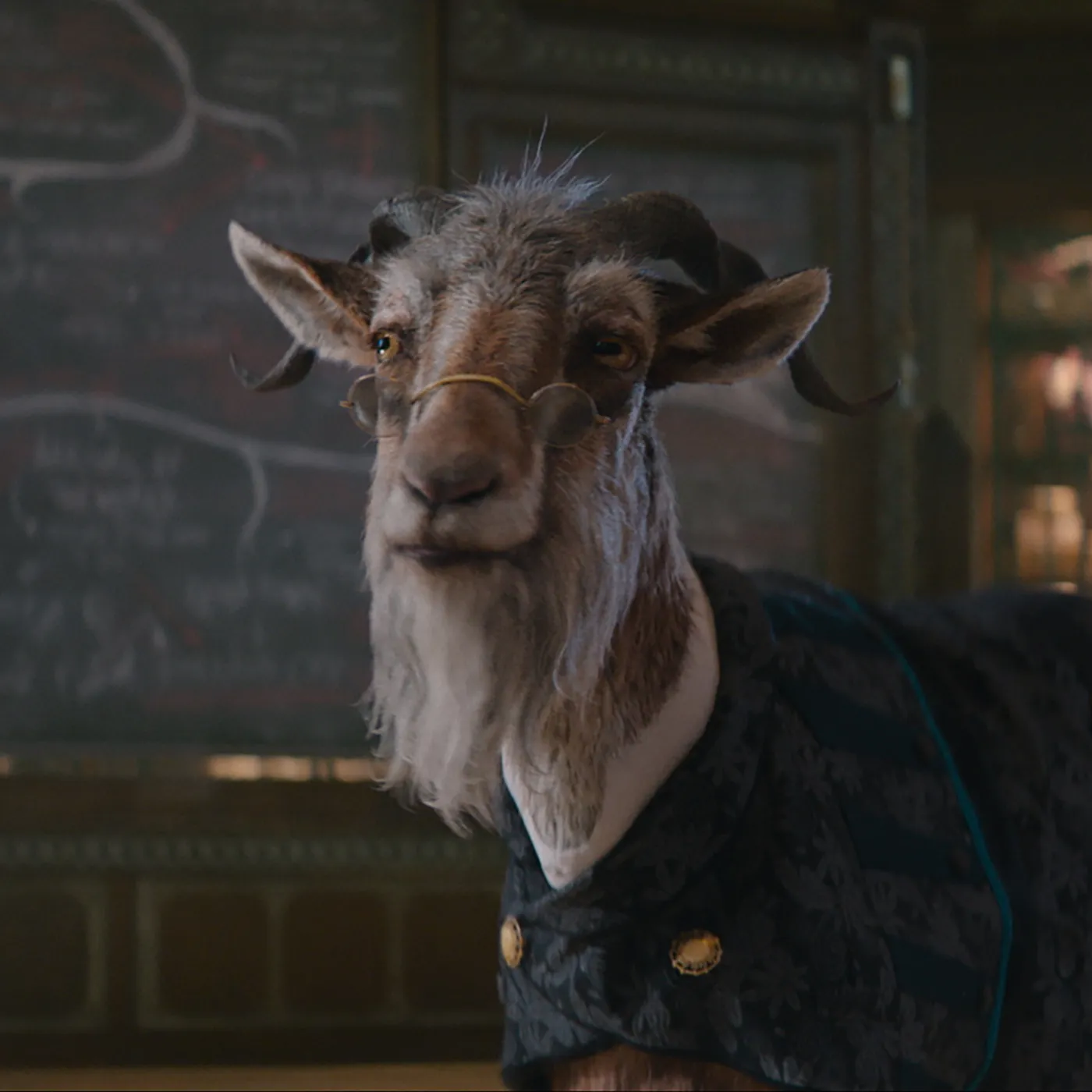

I wanna emphasize how good these aspects of the movie are, This movie was a visual smash, and I loved looking at it, if I could turn my brain off fully, this movie would get an easy 5/5, unfortunately, I cannot. Let's talk about the story.
Starting out with I wanna say there are two movies here, the musical itself, which justifies anything out of the movie to bring about good songs, and a compressed series of events to get that music and the general message of empathy vs sympathy, and the story that I would have liked to have seen. I am going to talk about the story I wanted to see, not about what the movie is in the following section, you have been warned!
The story of this movie is confused at best. While I don't wanna be too harsh on it, there are so many B plots that go nowhere this movie that it can be very distracting. A Broadway musical can get away with a somewhat rushed story, because the story isn't really always important factor, it can be a medium for music to play out. Here though, on the screen? it doesn't get such a pass. I will caution though, there is a part 2 coming apparently. Because of this, I cannot really accurately say if the B plots are truly pointless, or if they will becoming important in part 2. Regardless I think many of my complaints will stand either way.
Because of the numerous B plots, the movie becomes, in my opinion, messy and unfocused. So lets talk about the different strands. We have: Elphaba was bullied by her father for being green, The prince love triangle, Elphabas sister and her disability / love triangle, The animal holocaust thing???, Elphaba learning magic, Elphaba being popular. So letsssss go through them a little.
First off, The "a" plot is that Elphaba has to be green because she has to experience judgement while also not being an animal so she can understand the animals plight and look selfless helping them (if she were an animal it would of course be in her interest to help), Thus then the plot goes that she goes to the magic school, learns how to harness magic, finally realizes acceptance after becoming popular, realizes the animal holocaust is happening, goes to the wizard, realizes HE is evil, and becomes "wicked". Wow, ok, lots happening!
See, there's some issues, we set up that Elphaba is, in fact, discriminated against early in the movie. This is established so that she is empathetic to the animal cause, but then we spend damn near half the movie reinforcing this point instead of focusing on what is supposedly the driving force OF wicked: the animals! Elphaba's sister plays nearly no role in the story to progress this plot besides establishing why Elphaba is even at the college of wiz in the first place, the prince plot with the roommate is also pretty pointless, as it has nothing to do with wicked or Elphaba turning evil. Alpha becoming popular ALSO isn't particularly important as it only plays in the movie for like 5 seconds till she gets on the train to leave. The only person who needed to recognize Elphaba's beauty to progress the plot is Glinda! who needs to come with her to oz. In particular there was once scene, right after they save the baby leopard, she starts singing a love song?? very jarring.
In my personal opinion, and I realize this movie was more about the singing than the story, but in my opinion, this could have been one movie. Shunt the sister plot, shunt the love triangle, lock into Elphaba learning magic, Show more of the animal problems to build actual importance to their plot, Have her bond with Glinda in some other way, then go to Oz and learn the wizard is evil. This way we have real reason to see why Elphaba would be so upset, instead of just a vague " the animals are being captured" We are simply not really shown the issues, we are told them. (I cannot think of a single meaningful thing that the Munchkin boy Elphaba's sister falls in love with contributes to the movie)
Again, there is a part 2 coming, these B plots MAY amount to something eventually, but as it stands they're weak, and I didn't like them very much, and they detracted from the driving forces of our A plot.
Overall, if you like the wizard of oz and musicals and fun colorful movies, go see it. If you're looking for a thoughtful interesting plot... maybe skip it.
Comments
Displaying 0 of 0 comments ( View all | Add Comment )