


The History of the Pentagram - an old
article/blog I wrote, just cheating and making it into a blog
here.
Last Updated: 11
October 2013
The
pentagram was first used by Mesopotamians in approximately 3000 BC. In the
Babylonian context, the edges of the pentagram were probably orientations:
forward, backward, left, right, and "above". These directions also
had an astrological meaning, representing the five planets Jupiter, Mercury,
Mars and Saturn, and Venus as the "Queen of Heaven" (Ishtar) above.
The Pythagoreans called the pentagram Hygieia (meaning "health"; also
the Greek goddess of health, Hygieia), and saw the pentagram to represent
mathematical perfection. The five vertices were also used by the medieval
neo-pythagoreans (whom one could argue were not pythagoreans at all) to
represent the five classical elements of earth, water, air, fire and
spirit.
http://en.wikipedia.org/wiki/Pentagram
The
inverted pentagram was used by the Jews, and sometimes referred to as the seal
of Solomon. The inverted pentagram was used as the seal of the City of
Jerusalem, as early as the 4th Century BC.
http://www.thornr.demon.co.uk/kchrist/pent.html
The
(non-inverted) pentagram was also in use by the Knights Templar (e.g. on
gravestones).
www.thornr.demon.co.uk/kchrist/pent.html
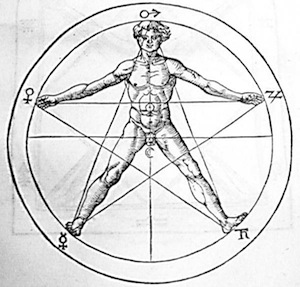
Heinrich
Cornelius Agrippa von Nettesheim (1486-1535) was a German magician, occult
writer, astrologer, and alchemist, who first popularised the pentagram in the
Western European Occult context. He used the pentagram (aka pentacle) in both
the 'regular' and 'inverted' forms.

http://en.wikipedia.org/wiki/Heinrich_Cornelius_Agrippa
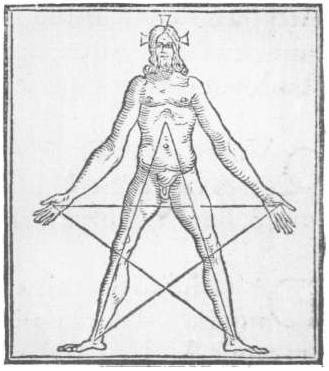
Medieval
Christians believed the pentagram to symbolise the five wounds of Christ. The
pentagram was believed to protect against witches and demons (the application
of the pentagram is similar to that of Occultists who use it as protection
against spirits during invocation and banishing rituals), e.g. The painting
'Christ as a Pentagram', from Valeriano Bolzani's Hieroglyphica (Basel, 1556),
seen below.

The
inverted pentagram was adopted by Mormonism from the 1830s to 1840s.
Albert
Pike stated that the Pentagram was synonymous with the Blazing Star of Masonic
Lodges.
www.freemasons-freemasonry.com/pentagram_freemasonry.html
By
the mid-19th Century, a further distinction had developed amongst occultists
regarding the pentagram's orientation and usage. With a single point upwards it
depicted spirit presiding over the four elements of matter, and was essentially
'good'. The inverted pentagram was considered 'evil'.
In
his 1855 book Transcendental Magic, its Doctrine and Ritual, Eliphas Levi
wrote:
"A reversed pentagram, with two
points projecting upwards, is a symbol of evil and attracts sinister forces
because it overturns the proper order of things and demonstrates the triumph of
matter over spirit. It is the goat of lust attacking the heavens with its
horns, a sign execrated by initiates."
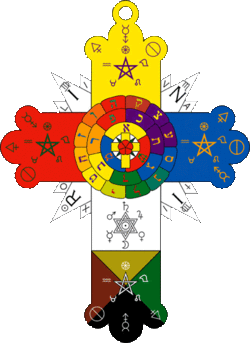
The
pentagram was first used by the Hermetic Order of the Golden Dawn, a
Rosicrucian/Theosophist Freemasonry Offshoot, probably sometime between
1888-1892. This usage and application of the pentagram for invocation and
banishing rituals has been widely adopted by Thelemists, Neo-Pagans, Theistic
Satanists and LaVey Satanists later in the 20th Century.
http://en.wikipedia.org/wiki/Hermetic_Order_of_the_Golden_Dawn

In
his 1895 book Magic, White and Black, Franz Hartmann wrote:
"Let
us keep the figure of the Five-pointed Star always upright, with the topmost
triangle pointing to heaven, for it is the seat of wisdom, and if the figure is
reversed, perversion and evil will be the result."
The
pentagram was adopted by many neo-pagans, especially Wiccans, as a symbol of
faith.

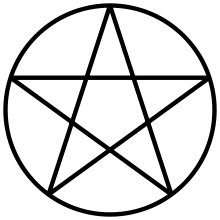
It
has also been adopted by the Baha'i faith as its symbol.
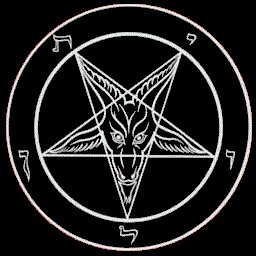
The
inverted pentagram was adopted by Anton LaVey and the Church of Satan in 1966
(with the Eliphas Levi's Baphomet), the downward pointing vertices representing
opposition to the Trinity. It is also used by the vast majority of Theistic
Satanists of various types.

Source:
Gustavo89
In
current magical use, the inverted pentagram has many different meanings. It can
represent the Wiccan Horned God (or Pan). The top of the pentagram represents
spirit over the physical elements, or invoking a spirit, so inverting the
pentagram can signify banishing a spirit. The pentagram can also be seen as
representing Leonardo Da Vinci's Vitruvian man (created in 1487), although it
was never actually used by Leonard Da Vinci himself (to my knowledge).
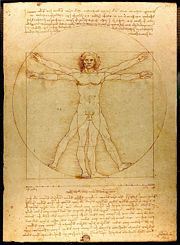
http://en.wikipedia.org/wiki/Vitruvian_Man

Clearly
the pentagram was in use by both Christians, Jews and pagans prior to the
adoption of it by the Mormons. However, the Mormons adopted the inverted
pentagram, which was used by the Jews in and around 400 BC, but which was mainly
used as a magical symbol from the 16th Century onwards. Christianity never used
an inverted pentagram to represent the wounds of Christ.
Comments
Displaying 0 of 0 comments ( View all | Add Comment )