



Hi there, welcome to my first post here. In this post, I'm going to be talking about why I think Japan has a genuine chance of winning the World Cup by 2050. And how the country’s willingness to learn and adapt to what they see as something better has led them to a road to success. I will be talking about the historical context to this and what steps they are taking on the football side of things.
Historical context
To start, we’re going back to the 1850s, when Japan was still very much an isolated country, known as sakoku. When Commodore Matthew C. Perry arrived in 1853 with a fleet of 4 armed warships and a letter from the then US president demanding trade by 1854, this deal was accepted and is known as the Treaty of Kanagawa. As a result, Japan realized just how technologically behind it was compared with the rest of the world. By 1861 Prussia, led by Count Friedrich Albrecht zu Eulenburg, got Japan to sign a treaty that did not benefit Japan; however, it did allow Prussian integration. This led to Japan modelling its own government after the Prussian state, veiwinf it as the ultimate model. By 1885, Japan began modelling its own military after the Prussians, hiring Major Jakob Meckel to perform a complete overhaul of the Imperial Japanese Army, training the Army in tactics and strategies. This leads us to the Russo-Japanese War, a war in which Russia was expected to easily defeat Japan, bearing in mind that Japan’s borders had been open for just over 50 years up until this point. That was not the case, with Japan defeating Russia and firmly asserting itself as one of the world’s military powerhouses. Something which stays true to this day.
What does this tell us? This tells us that Japan has a willingness to learn and take in information that they lack and implement it to massive benefit. And you see this in multiple different ways through the country's history; one of the most notable in recent years is baseball.
In 1934, Babe Ruth and Lou Gehrig played a handful of exhibition games in Japan at a time when baseball was on the up in the country, with Kōshien high school baseball regularly selling out high-capacity stadiums. These exhibition games led to an even greater explosion of interest within the sport. Leading to the foundation of Japan’s oldest baseball team, the Yomiuri Giants. Following this success, they sought out help realising just how big baseball can be; they asked Lefty O'Doul and Connie Mack to be bridges, consultants, and mentors in hopes of making the Japanese baseball league a success they went on to adopt the MLB's franchise model; all of this became a catalyst to the foundation of Japan’s first professional league. Another team born from the 1934 foundation of the league was the Nankai Hawks, who featured what went on to be the first Japanese player to break into the MLB. This leads us to today. Where, due to the popularisation within Japan as well as the foundation of the league, which they sought help for, Japan holds host to the second highest paid player in MLB history in Shohei Ohtani, who is also undoubtedly the most unique player to grace the sport.
What does this show? This shows that despite the already high popularity of baseball in Japan, it was still willing to adapt and learn to create the professional Japanese baseball league.
You’re probably thinking, “What has any of this got to do with football?” right? Well, don’t worry; we’re here now. West German coach Dettmar Cramer was invited to coach the Japanese national team in 1960, specifically brought in to strengthen the team in preparation for the 1964 Tokyo Olympic Games, and in a similar vein to the Prussians almost a century ago, he used this as a platform to educate the country when he arrived the players severly laacking in technical skills he set about improving this by intensive coaching in the basic skills rather than getting the team to play games he got them to learn how to play football.
However, what was probably the biggest thing he did was teach and train the Japanese coaches in his methodologies to further help the development of Japanese football. The JFA credited him with laying the foundation of Japanese youth football. At the 1964 Olympic Games, Japan beat Argentina 3-2 in the group stage before being knocked out by Czechoslovakia. Then at the 1968 Olympics, Japan went on to finish 3rd, a massive improvement in just 8 years, all led by one man and a country’s willingness and eagerness to learn.
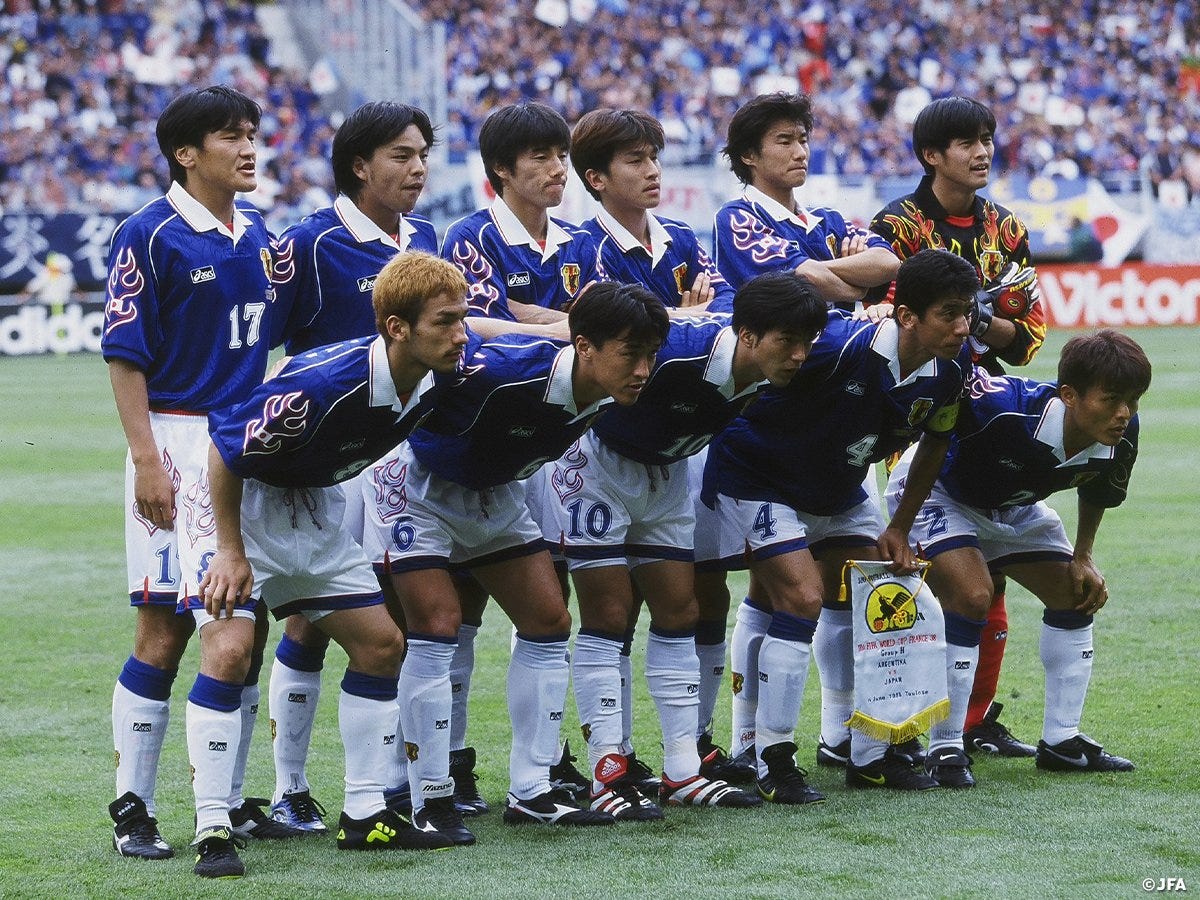
In 1977, Japan founded the National Training Centre to develop and identify promising players who would contribute to the national team, and rather than choosing to develop a team, it chose to develop the individual players. Then, in 1991, the J-League was established; this gave a place for this rising Japanese talent pool to have professional development while the JFA provided further high-level training and pathways for these younger players. With the J-League. This all cultivated together led to Japan winning the 1992 Asian Cup with a 1-0 win over Saudi Arabia; This was just their second time competing in the competition and they again tasted success by qualifying for the 1998 World Cup, the first in the country's history. All of this, the founding of the J-League, being able to bring in high-level foreign players (to help expand the game both nationally and internationally), winning the Asian Cup, and qualifying for its first-ever World Cup, all of this in just 38 years since taking on board what Dettmar Cramer had come to Japan to teach them, once again showing that willingness to learn. And if we compare this to when the Treaty of Kanagawa was signed just over 50 years later the went from an isolated country to one of the strongest militaries in the world and in present day we are just over 50 years from when Dettmar Cramer came over to Japan and became teaching them his ideologies.
This takes us to the ultimate question…
Can Japan ACTUALLY win the World Cup?
Yes, I believe by 2070 they will win the World Cup because of the reasons mentioned above; the country as a whole is so eager to listen, learn, improve, and ultimately become one of, if not the best at that, in the world.
Now obviously in football having the best players ≠ guaranteed success; look at England for example. But it’s what those elite players do for their team is what’s the most important part. If you think back to the most recent World Cup, in which Spain won, Lamine Yamal was expected to shoulder a majority of the team’s attacking output due to him being their best player; however, he only ended the tournament with just 1 goal and 0 assists. Does that mean he had a bad tournament? Yes, but he was battling with slight injury problems going into the tournament, which would’ve had a slight impact, especially after playing 3700 minutes in the season just gone. However, where Yamal also shone was the ability both on and off the ball to platform the players around him. You also see this with some of the other world-best players like Ousmane Dembele who was willing to do the off-the-ball work for France to allow Mbappe to conserve himself. This is where I believe Japan will win their World Cup.
If you again think about how willing they are as a country to learn and improve and become the best, it is my feeling that Japan will cultivate a footballing culture of self-sacrifice for the betterment of the team. And it wouldn’t surprise me if they again look to bring in some of the world's best coaches in the modern day to implement that, and with that willingness to learn, these ideologies will be taken on board far more easily than most other nations when attempting to do similar.
Another factor, and probably the most obvious, that will play a massive part in their hunt for the World Cup is player development. According to CIES Football Observatory, 276 Japanese players have transferred to Europe between just 2020 and 2025. You’re currently seeing this in the current transfer window, with Japan’s starting goalkeeper at the World Cup, Zion Suzuki, looking set to join Aston Villa for a fee of around £30 million (at the time of writing). Other U23 players such as Kōta Takai, currently contracted to Tottenham, Kodai Sano, who himself is coming off an incredible campaign with NEC Nijmegen, playing a massive role in helping the team qualify for the Champions League for the first time in their history; this earned him a move to current Dutch champions PSV, and Ryunosuke Sato, who looks like a real gem for the country winning the U23 Asian cup MVP at just 19, scoring 4 goals in the tournement. You also have already established stars like Brighton’s Kaoru Mitoma, Takefusa Kubo, Kaishu Sano, Hiroki Ito, Ritsu Doan, Daizen Maeda, and Daichi Kamada (also shoutout Yuto Nagatomo, now 39, who’s made a combined 242 appearances for Inter Milan, Galatasaray, and Marseille).
You also have some very iconic players of the past like Shinji Kagawa, Shunsuke Nakamura, Shinji Okazaki, and most notably Hidetoshi Nakata, who became the first-ever Asian player to have been nominated for the Ballon d’Or. And that brings us to the future generation of Japanese football, and what actually inspired this entire blog and rabbit hole I went down was seeing a TikTok of young Japanese players at a training camp dribbling the ball in ways you'd typically associate with Brazilian or Spanish football, with ball manipulation that is honestly terrifying at that age (this also led me to an old video of the aforementioned Daichi Kamada dribbling through chairs in his school’s corridors, which I just thought was pretty cool) and seeing the technical coaching that has been brough over implamented in so many differant ways, as lets not forget Kaoru Mitoma wrote a thesis on 1V1 dribbling in football when he was 19.
So with all of that in mind, I truly do think that Japanese football is on an inevitable collision course with success, success that can be traced all the way back to 1860 and one German with coaching principles that can still be seen today.
Comments
Displaying 1 of 1 comments ( View all | Add Comment )
blvkmoon
by 2050, romania will finally join the world cup again