


Today while preparing some tomatoes for canning, a few yellowjacket workers came by get some sugars from the discarded tomato skins. Summer is now officially coming to an end when the social wasps begin their desperate searches for sugars.
The point of this blog entry, is to defend my friends the wasps - mainly the social wasps (paper wasps, yellowjackets, hornets - the wasp species that live in a social hierarchy and create paper nests). Nearly all wasps are solitary species that people barely pay any mind to or even acknowledge the existence of. Yet everyone knows who the social wasps are. Social wasps are probably some of the most maligned and misunderstood insects in the world. You are frequently met with the idiotic attitude of "bees are friends, wasps are assholes", or the whole "kill it with fire" trope.
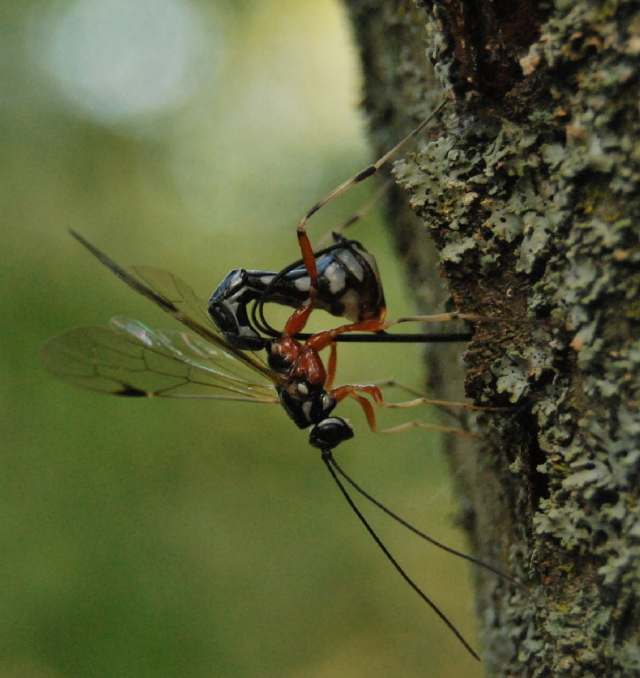
Solitary wasp species - Rhysella humida - ovipositing in wood - my own photo
The myth of "aggression" in social wasps. Wasps are not aggressive. Wasps are defensive. The utterly foolish idea that wasps seek out people just to sting them out of some spiteful rabid hatred for humans. No they don't, and you can piss off with your stories about "that one time" you got stung for no reason. I guarantee there was a reason. You came too close to the nest, you applied physical pressure to the wasp, the wasp accidentally flew onto you and panicked.
Why do social wasps get more irritating in the late summer? They're starving to death. In the spring, a foundress (let's use the term "foundress" instead of "queen". Queens are reserved for ants, termites and honeybees) emerges from her winter sleep (I'm using a North American bias here), and finds a location to start her nest. She lays eggs in the cells of the nest she creates, which emerge into workers. While the workers are in their larval stage, they secrete a sugary substance which feeds the foundress, and eventually, as the colony grows, the ensuing larvae feed their sisters and so on. But to feed the larvae, the workers must go out and hunt other insects, or find other meat sources. The workers then take the meat back to the larvae, who reward the workers with the sugar. Workers don't eat meat, they only eat liquid sugar.
So as the season comes to an end, and all of the larvae have flown off into adulthood, the wasps must now find sugars/nectar elsewhere; flowers like goldenrod. And to kill another myth made by fucking imbeciles "wasps don't pollinate". Wasps are pollinators, tremendously so. Then the flowers begin to shed their seeds and die as autumn comes into full force. The wasps have no more flowers, or very few flowers left for nectar feeding. The wasps are desperate and now resort to trying to get sugars from our barbecue picnics, fruits, soft drinks, beer, whatever we've got that has sugar.
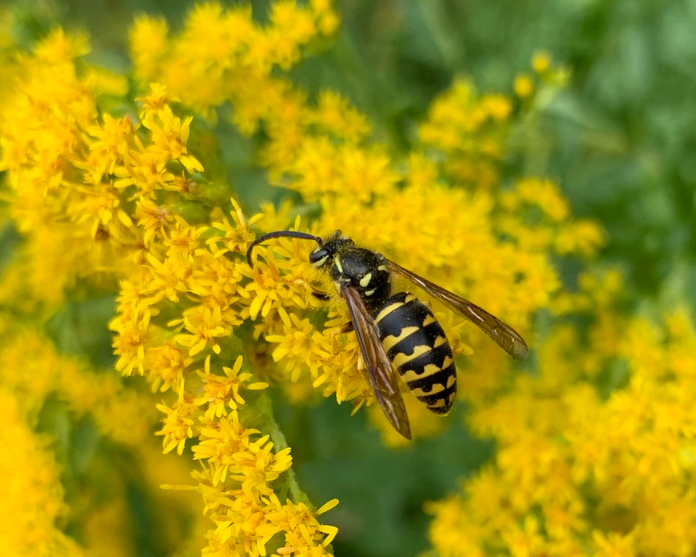
Common aerial yellowjacket on Canada goldenrod - my own photo
Thus ends my plea for understanding these animals, and the close to death situation they are in at this time of year in Northern North America. They've worked all summer providing for their sisters, controlling pests, and pollinating. Leave a little dish of sugar water out for them, especially once the flowers wilt and fade.
I fucking had to.
Comments
Displaying 7 of 7 comments ( View all | Add Comment )
Will
As one of those who "can piss off," this reads like the pitbull advocacy people, who deny the realities of differences in breeds of dogs (for politically correct reasons).
It clearly defies common sense when I can enter my hive of Italian-based honeybees without a suit or a sting, but when I go out my door wasps or hornets that were 5 feet away dive in to butt or sting me on the neck. And there is a clear difference between Italian and African honeybees, going back before domestication.
Honeybees can get aggressive, too, when the weather is bad or they are being invaded by beetles, or what have you, of course, and they have been domesticated, but that domestication had to start somewhere and it started with only certain groups of honeybees (in Africa, the "killer bees" were not domesticated, the people relying instead on mutualism with a bird, the Honey Guide, to find honey for harvesting), with selective breeding measures coming much later (and with a strong preference toward more gentle Italian and Carniolan bees).
Whatever the statistics isolated in a lab may or may not say, common sense screams something different, such that you feel the need to pre-empt the response. That difference is consistent with the few domestic clades of bees that have been artificially selected and the fact that a sting from a bee is a suicide for the bee, while the sting of a wasp was just a stabbing that can be repeated. Of course this will correspond to a difference in behavior, or the evolutionary psychology of Hymenoptera species.
While feeding sugar water to domestic bees is mildly acceptable at times, feeding wild bees, wasps, and hornets foods that they cannot forage on their own serves to weaken the species and make them dependents upon humans by easing selective ecological pressures and subsidizing otherwise unstable genetics (considered in terms of kin selection, not as isolated breeders, owing to their eusociality). For this reason, we refrain from feeding sugar water even to domestic bees. Natural selection knows best. If we don't have a mutualism to establish between us (as we did with the bees), it's probably best not to cause a dependency.
As with the pitbulls, it seems something is being downplayed on the basis of sentiment. But one doesn't have to deny ugliness in something for it to be important or useful. And it is better not to meddle with natural systems, lest you turn them into artificial systems, thereby ensuring a trophic collapse accompanies a civilizational one, should that occur.
Oh buddy, I am not in any way advocating for people to feed wasps regularly. It can be a slightly enjoyable activity to feed these animals some sugar water out of a sense of pity as they come into their death throes in mid to late October -- a very natural and normal occurrence. I'm not in any way suggesting you have dishes of sugar water out at all times so that wasps become dependent on humans. Absolutely fucking not, man. I want these animals to remain wild and remain in healthy and stable populations, so that they continue to provide their services to nature. That's it. And if feeding some some sugar water can help fearful individuals overcome their fears, even better.
Hilarious to say that I am similar to the 'pibble' advocates out there. Tammy's little cupcake muffin princess is a domestic animal and is fully capable of flat out aggression. A wasp is wild, a wasp is acting purely out of instinctual defence. I'm not anthropomorphizing wasps as little misunderstood pitbulls. I'm trying to illuminate why they act the way they do in the late summer/fall, and to have some understanding and maybe even compassion for a small animal.
by Kommando Mutiliid; ; Report
In addition, Will, I am very aware of the fact that bees can also be defensive. I may not have your experience with honeybees, as my experience is wholly with wild bees. I actually do quite a lot of work with wild bees and I've felt the full force of their defensive wrath. In my entry, I was mocking the popular idea that many people have; that bees are the entirely useful ones in terms of ecological services (pollinating), whereas wasps are viewed as contributing nothing. Don't you worry, I love both of these insects groups equally, including the non-native honeybee.
by Kommando Mutiliid; ; Report
I didn't catch the first reading that those were your own photographs. Great job on those.
Your point that wasps and hornets are downplayed in favor of bees is accepted. I agree. I would also say that about non-honey bees, like bumble, carpenter, and etc. bees. But there is also something special about the mutualism we can have with domestic bees.
I only intended the pitbull analogy insofar as pitbulls are slightly more dangerous than other breeds but, in their defense, this slight difference is downplayed altogether by advocates for the sake of making an appeal for a presumed equality (so they are not discriminated against). The truth is that pitbulls are potentially more dangerous, and so maybe don't belong in apartment complexes or tied behind a trailer, but can still be good dogs if kept right. Similarly, wasps and hornets can be more aggressive, but we still need 'em around (as you already know)!
The general line of thought spoke to a kind of personalist/communitarian approach I am critical of from the vantage point of evolutionary sociology, whereby the dignity of the wasps, in this case, was being framed by downplaying their negative factors, appealing to pity, and suggesting assistance be given toward them as particulars. This is what is done with pitbulls, special interest groups, and, in this case, wasps were fitting the framework.
It's unlikely to be intentional on your part. But it is something that has been imposed culturally as a paradigmatic sensibility (we learn this sort of pity from Bible stories or watching cartoons as children, for instance, in place of conceptions of justice), and so widely conditioned in us, such that it is not strange that you reflect it here.
Herbert Spencer, a father of evolutionary thought, warned against sensibilities and pity of the (soon-to-be) personalist/communitarian sort, in specific, for evolutionary purposes, saying instead that
There is, he says, "unquestionably harm done when sympathy is shown without any regard to ultimate results." My statement is basically an echo of his thought.
Spencer-- like Pierre Proudhon, namesake to Pierre-Joseph van Beneden (who gave us terms like mutualism and parasitism), both of whose views were similar to, and the prior of which he was compared to in his lifetime--, and as an individualist rather than personalist/communitarian, believed it was more important to use one's own well-informed conscience, which took into rational consideration long-term consequences, than to give into emotive sensibilities, pity, and charity that was damaging yet popularly cheered and politically affective for bandwagoning.
Sensibilism and personalism-- which give style to your framing here purposefully or by accident of inheritance-- have had negative sociological consequences. So I worry about those consequences being extended to the wilderness, as well as doubling-down on the problem by encouraging a culture of charity where there could instead be a culture of self-determination and justice (equal freedom, internalization of costs). That is, the habit of giving charity to animals reflects the opinion that doing charity is good and necessary, but charity has historically been the substitute for freedom from exploitation, such that charity corresponds to destitution. The habit of charity is, itself, because of this, problematic at its foundation. "Let them be" or "do no harm" would be my preferred homage.
Pity, by this view, should generally be reserved for those whose self-determination is impeded by an act of aggression or who is harmed by irregular external forces beyond their control ("Acts of God" like a tree randomly falling on them, lightning striking them, or etc., disincluding regular events like seasonal changes). This would include people of one's own society like tenants, employees, debtors, and subjects of courts and governments, as well as other victims of crime; but would disinclude outsiders of the society, including wild animals.
The idea here is that a society, whether a human society or a eusocial superorganism, functions as a cooperative whole much like a body functions as a cooperative unity of organs, tissues, and cells, and on that basis can be taken as a unit of selection as a whole, with its members cared for as organs of the body. This cannot be said between societies, except so far as they are emerging supersocieties or macrosocieties, as we arguably have today, but which does not extend to wild animals nonetheless. And even still, rights of self-determination, not charity, should be the rule. Charity/welfare works best in the war room as a means of cultural defeating foreign nations (as China had been doing with us by subsidizing our cheap plastic crap while it takes the "burden" of industry from out of our hands and upon itself) or in Congress as a means of subduing the working class (as with the capitalist, corporatist, or state-socialist economic systems).
It may seem strange to bring political sociology into it, but the two (pity toward creatures and sociology) are intertwined, especially in evolutionary thought and the history and sociology of the philosophy of science coming out of Victorian origins. As pointed out, evolutionary thought stems largely from Spencer and van Beneden's namesake was a sociologist, such that much evolutionary thought came from sociology and influenced biology, rather than the other way around, making sociology relevant when treated biological and ecological phenomena.
by Will; ; Report
Naynoro
I think the general hate for all bugs/insects is so stupid. I try my best to not kill any bugs these days, but with summer coming up it has become increasingly more difficult. I hope all the little spiders are safe, my sister told me to kill one on our walk the other day.
_c3L_1105
I know they're also farsighted but I hate it so so much when they fly near me ;; (can't researches make lil glasses for them, I mean they would def look cuter with them on lol)
worldsoul
Thank you, wasps. I'm sorry I ever scorned your kind.