



Reproduced from my web site, written around 10 years ago or so. I probably need to re-edit it or write it from scratch now.
Lucifer
is the word meaning 'light bearer' (from lux, lucis, "light", and
ferre, "to bear, bring"), a Roman astrological term for the "Morning
Star" the planet Venus. The word Lucifer was the translation of the
Septuagint Greek heosphoros, ("dawn-bearer"; cf. Greek phosphoros,
"light-bearer"; itself the translation of the Hebrew Helel ben Shahar,
Son of Dawn), used by Jerome in the Vulgate, having mythologically the
same meaning as Prometheus who brought fire to humanity.
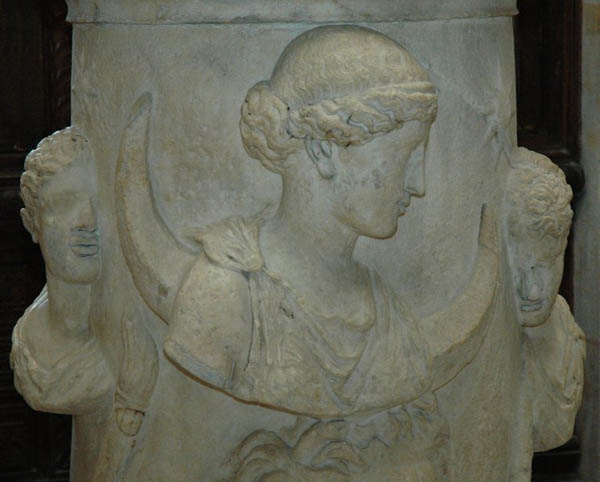
Below is a 2nd-century sculpture of the moon goddess Selene
accompanied by Hesperus and Phosphorus: the corresponding Latin names
are Luna, Vesper and Lucifer.
One form of phosphorus (white phosphorus) emits a faint glow upon
exposure to oxygen (hence its Greek derivation and the Latin
'light-bearer', meaning the planet Venus as Hesperus or "Morning Star").
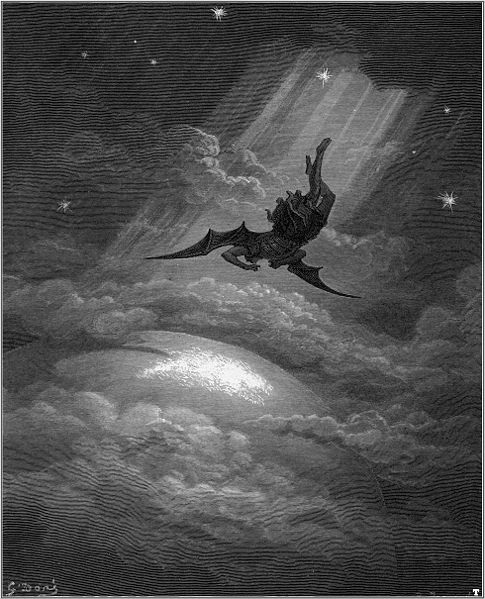
Two illustrations of Lucifer (as Satan) by Gustave Doré's for the
17th Century work Paradise Lost by John Milton, are shown below. These
drawings may well have contributed in part to today's notion of Lucifer
being Satan and a fallen angel.

A statue of one of twelve Lucifers on the (Catholic) Holy Trinity
Column in Olomouc in Olomouc (Czech Republic), built in the 18th
Century, is shown below.
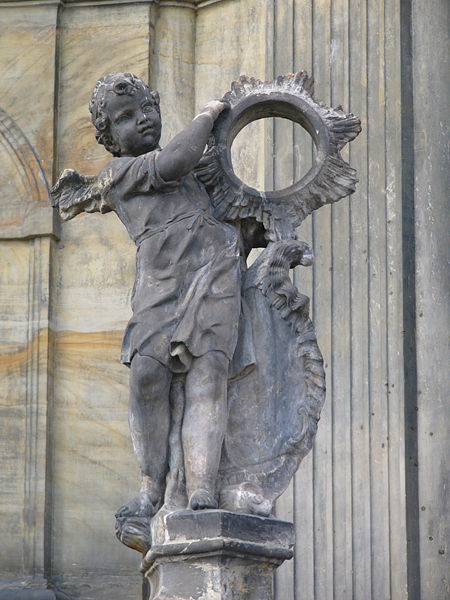
Source: Michal Manas.
A statue of Lucifer, by Guillaume Geefs (Cathedral of St. Paul,
Liège, Belgium), from the 19th Century, is shown below. It may well have
been inspired by Gustave Doré's illustrations.
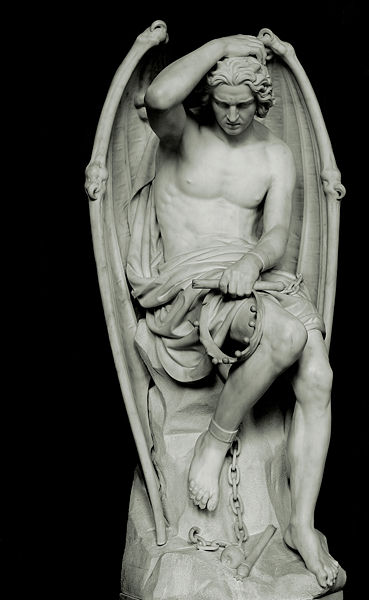
Source: Luc Viator
Clearly the depiction and concept of Lucifer has changed dramatically
over the millennia, from the Roman era to the pseudo-Christian vision
of the last three centuries.
The Sigil of Lucifer, used by Theistic Satanists and some Luciferians and Gnostic Luciferians, is shown below.
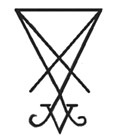
Source: Ssolbergj
Lucifer is known as the 'God of Morning Light', the bringer of illumination, wisdom and knowledge, etc. and has its origins with the Roman God and planet Venus. The metaphor of the Morning Star is often overused by self-proclaimed Luciferian circles often to the point of losing sight of the historical origins and astronomical reality, in that the planet Venus do not emit much light or illumination at all, but merely reflects it, and is useful for navigation only, and not illumination in the sense of the light received from the sun or the reflected light from the moon where you can actually see where you are going.
There are many types of Luciferianism so it is easy to confuse them. This section aims to explain the difference between the Luciferian Sects. Historically speaking, there is no direct connection between the Roman God Venus and Luciferianism as it exists today. Most Luciferian Sects do not recognise Jesus Christ with the exception of Gnostic Luciferianism and those historical followers of Saint Lucifer (Lucifer Calaritanu). Strictly speaking, Gnostic Luciferianism recognises the Gnostic Jesus as opposed to the New Testament Christian view of Jesus. Also Gnostic Luciferianism differs from all other forms of Luciferianism in that it regards the creator of the world and indeed Universe as Demiurge, whereas other types of Luciferianism usually associate this with the main deity they worship (e.g. the Grand Architect of the Universe and purveyor of wisdom). Gnostic Luciferians may also surprise some Christians as much of what they say appears almost identical to that of Gnostic Christianity or progressive Christianity. Clearly it depends on context and at other times Gnostic Luciferians may also sound like Satanists.
Diane Vera describes Lucifer on her web site here.
Luciferianism is often identified as an auxiliary of Satanism, due to the popular identification of Lucifer with Satan. Some Luciferians accept this identification or consider Lucifer as the light bearer aspect of Satan, or even as equivalent to Satan, and thus could properly be called Theistic Satanists. Others reject it, arguing that Lucifer is a more positive ideal than Satan. They are inspired by the ancient myths of Egypt, Rome and Greece, Gnosticism and/or traditional Western occultism.It is possible that the Nag Hammadi library's 'On the Origin of the World' describes 'Lucifer'. Whilst there is no explicit mention of Lucifer, it does describe the 'Man of Light', a type of immortal banished from his realm, who brings light. is a reference to 'Lucifer', although no explicit mention of Lucifer is made in the scroll, and it is not a Christian text, but it is possible it could have influenced Christian thinkers in later centuries.
And when he had come to know in truth that an immortal man of light had been existing before him, he was greatly disturbed; for he had previously said to all the gods and their angels, "It is I who am god. No other one exists apart from me." For he had been afraid they might know that another had been in existence before him, and might condemn him. But he, being devoid of understanding, scoffed at the condemnation and acted recklessly. He said, "If anything has existed before me, let it appear, so that we may see its light." And immediately, behold! Light came out of the eighth heaven above and passed through all of the heavens of the earth. When the prime parent saw that the light was beautiful as it radiated, he was amazed. And he was greatly ashamed. As that light appeared, a human likeness appeared within it, very wonderful. And no one saw it except for the prime parent and Pronoia, who was with him. Yet its light appeared to all the forces of the heavens. Because of this they were all troubled by it.... Now when Adam of Light conceived the wish to enter his light - i.e., the eighth heaven - he was unable to do so because of the poverty that had mingled with his light. Then he created for himself a vast eternal realm. And within that eternal realm he created six eternal realms and their adornments, six in number, that were seven times better than the heavens of chaos and their adornments. Now all these eternal realms and their adornments exist within the infinity that is between the eighth heaven and the chaos below it, being counted with the universe that belongs to poverty.
Traditional Luciferianism was a (heretical) pantheistic thirteenth-century German sect which held that Lucifer should be worshiped as the ruler of the material world. This concept of the material world as Lucifer's domain was, most likely, taken from Catholic Christian doctrine and his titles in the (presumably Latin Vulgate) Bible as 'the god of this world' in 2 Corinthians 4:4 and 'lord of this world' in John 12:31.
John 12:31 (KJV): Now is the judgment of this world: now shall the prince of this world be cast out.
2 Corinthians 4:4 (KJV): In whom the god of this world hath blinded the minds of them which believe not, lest the light of the glorious gospel of Christ, who is the image of God, should shine unto them.
Presumably this Sect regarded Jesus as a false messiah, although this is speculation and I do not have any further information on this.
Lucifer is the God described by the famous Grand Commander of the Scottish Rite, Southern Jurisdiction, Albert Pike, in the Scottish Rite book Morals and Dogma.
In the Instructions to the 23 Supreme Councils of the World, July 14, 1889, Albert Pike was recorded by A.C. De La Rive in La Femme et l'Enfant dans la FrancMaconnerie Universelle on page 588 as having said that Freemasonry in its purest form should embody the Luceferian Doctrine and that Lucifer was the real God, not Adonay. Adonay is the Hebrew word for Lord, used to describe either the Hebrew God 'Yaweh' or Jesus Christ.
In a letter dated 15 August 1871, addressed to Grand Master Guiseppie Mazzini 33° (Archives British Museum, London, England), Albert Pike wrote that atheism and nihilism shall destroy theism (Christianity) and civilisation, unleashing bloody terror.
Pike regarded Jesus at most to be a man, and accused him of being an atheist, a blasphemer, the god Hercules, the founder of a religion of hate etc. An extract from Albert Pike's Morals and Dogma book can be found here, containing references to the Greek God Prometheus.
Some classically-educated Freemasons and those inspired by their work claim to use 'Luciferian' in the scholarly sense of 'bringing enlightenment', invoking the Greek deity Prometheus. Whether these individuals were Gnostic Luciferians or just Prometheus worshippers is not certain. The implication from Albert Pike's writings in general is that he was some manner of polytheist, interested in Egyptian mysticism, with a particular anti-Christian reactionary stance. Whilst literal interpretation of his words might assume he was referring to Lucifer as a literal deity, like Adonay, those who are familiar with Pike's works would interpret this metaphorically, meaning Lucifer as a reflection of the light of the self and the light of Wisdom. Whether he was viewing the 'Grand Architect' as being the 'God' he hated or not is unclear. He used Baphomet as a symbol of resistance against Chrsitianity so perhaps Lucifer was used in the same way. Pro-Catholic polemicists linked such masonic usage with Sects whom they believe were worshipping Lucifer, which they believed have had persistent groups of followers since the Middle Ages.
Modern Luciferianism is a similar theology to Traditional Luciferianism, usually modelled on a panentheistic view of Lucifer as being all encompassing essence of the Universe (an essence or God that pervades the Universe, but which makes up each person, each person having the potential to become 'God' or 'a God'). The lines between Modern Luciferianism and Gnostic Luciferianism are often somewhat blurred.
An overview of the roots of Luciferianism and symbolism are examined in the article 'Luciferianism: The Religion of Apotheosis' by Phillip D. Collins (2006). Luciferianism is the product of 'religious engineering', which sociologist William Sims Bainbridge defines as "the conscious, systematic, skilled creation of a new religion" in his book New Religions, Science, and Secularization".
Helena Blavatsky, the founder of the Theosophical Society, established an occult magazine entitled 'Lucifer' in London in 1887.
Comments
Displaying 17 of 17 comments ( View all | Add Comment )
Shemyazza_LXT
Really interesting read. I especially appreciate the distinction between Lucifer as the Morning Star / light-bearer and the later identification of Lucifer with Satan and the fallen angel tradition.
I've been researching some of these subjects myself, particularly the development of Luciferian symbolism, apocryphal traditions and the Watchers in 1 Enoch, so I enjoyed seeing the historical layers separated instead of treating every tradition as if it came from the same source.
I'd be interested to know whether, if you rewrote this article today as you mention at the beginning, your interpretation of Lucifer or modern Luciferianism would be different.
Thanks for the feedback.
'Also Gnostic Luciferianism differs from all other forms of Luciferianism in that it regards the creator of the world and indeed Universe as Demiurge, whereas other types of Luciferianism usually associate this with the main deity they worship (e.g. the Grand Architect of the Universe and purveyor of wisdom).'
I'm not sure why I wrote that. I did not really consider atheists and agnostics here. I think it is elaborated more in another article I wrote. And the word 'worship' is problematic. My basic interpretation of Lucifer would be fairly similar.
by Fabian; ; Report
Thanks for the reply! I actually find your point about the word “worship” really interesting.
I think that word can make discussions about Luciferianism confusing, because “worship”, “veneration”, seeing Lucifer as an actual deity, or understanding Lucifer as a symbol/archetype of knowledge and rebellion can describe very different relationships.
Personally, that's one of the things I find most interesting about Luciferian traditions: there doesn't seem to be a single interpretation of what Lucifer actually represents.
Since you said your basic interpretation hasn't changed much, how would you describe Lucifer today? More as a deity, a spiritual figure, an archetype, or something else?
I'd genuinely be interested in hearing your view.
by Shemyazza_LXT; ; Report
I think many theists have a thing about worship, in LHP and RHP, and I personally think it derives from previous understandings of Christianity. I have met many theistic Satanists and Luciferians who say they worship Satan or Lucifer and I struggle to see how this is really LHP but that's just me. Ok there is a Lucifer in the old grimoires, because of the historical title of Lucifer. I go with archetype represented by different named deities/archetypes. I don't keep up with what most Luciferians on the web are spouting tbh, most of it seems rather like new age Satanism.
by Fabian; ; Report
That's actually quite close to something I've been thinking about myself.
I agree that the language of "worship" can carry a lot of baggage inherited from Christianity, especially when people leave a Christian framework but unconsciously keep the same relationship between deity and believer, only changing the name of the deity.
Your idea of an archetype represented through different named figures is particularly interesting to me. Where I become cautious is in treating historically distinct figures as interchangeable. Lucifer, for example, has accumulated layers from Roman astronomical terminology, Christian interpretation, literature and later occult traditions. Shemyazza comes from a very different textual tradition, and Lilith has her own complicated development.
They can perhaps embody overlapping ideas without necessarily being the same figure.
That's actually one of the reasons I enjoy going back to the older sources. I'm interested in seeing where the historical figure ends and where later interpretation begins.
And I think we probably agree on another thing: modern internet Luciferianism can sometimes make separating those layers rather difficult. 😄
by Shemyazza_LXT; ; Report
Yeah when I think of Lucifer as a deity or entity I generally think of something like Prometheus and Venus. Edward O'Toole created a kinda of zen gnostic LHP system and his idea of "lucifers' included philosophers or people like Rasputin, Machiavelli, Nietzsche, and figures like the gnostic Jesus, etc. Which I found an interesting idea, but it depends how you work it into your magic I guess. Yeah clearly all these archetypes or philosophies are slightly different. I would not expect all forms of wisdom to come from one source and indeed some of it might contradict others, but depends on interpretation. Yes generally any phenomenon on the web that gets average internet users involved is usually trash haha
by Fabian; ; Report
Yeah, I think that's probably where our views overlap quite a bit.
I like the Prometheus comparison, especially if Lucifer is understood as a symbol of illumination, questioning established authority and the pursuit of knowledge. But I also wouldn't want to collapse Prometheus, Lucifer, Shemyazza, Lilith or other figures into a single universal entity wearing different names.
For me, their differences are part of what makes them interesting.
Shemyazza is a particularly good example. What attracts me to that figure comes specifically from the Enochic tradition: the boundary being crossed, the transmission of forbidden knowledge, the consequences of that act, and the ambiguity of a figure who can be interpreted very differently depending on the framework you're using.
Lucifer carries a completely different historical development.
So I tend to think in terms of related symbols and recurring themes rather than one ultimate source behind all of them. Sometimes they overlap beautifully; sometimes they contradict each other, and I don't necessarily see that contradiction as a problem.
In fact, trying to force every tradition into one perfectly coherent system probably tells us more about the modern interpreter than about the original traditions. 😄
And yes, once the internet gets hold of something, give it enough time and somebody will turn it into a TikTok spirituality starter pack. 😂
by Shemyazza_LXT; ; Report
Yes I agree. I find the symbolism over/misused. I guess it's like LHP McDonalds.
by Fabian; ; Report
"LHP McDonald's" 😂
That's actually a perfect way of putting it. Take a little Lucifer, a little Baphomet, some Lilith, throw in a few sigils and a Nietzsche quote, and apparently you've got the spiritual Happy Meal.
Jokes aside, that's exactly why I think going back to the sources matters. The symbolism becomes much more interesting when you understand where it actually came from instead of treating it all as interchangeable decoration.
by Shemyazza_LXT; ; Report
lol good one yeah it becomes very superficial and loses its meaning and becomes a lot of fluff. I haven't looked at those scrolls in so long and last time I looked it seemed like double dutch lol
I know a lot of booksellers who sell the same predictable occult books and a lot of really crap quality ones, and I refer to them as occult mcdonalds. they have these big on line stores, really salesy and there's no personal touch at all. Just really commercial.
by Fabian; (edited); Report
"Occult McDonald's" might actually be even better. 😂
And I think that's the real danger of it. Once a tradition becomes a product, complexity isn't particularly marketable. It's much easier to sell a recognizable aesthetic and a handful of familiar symbols than the history and contradictions behind them.
There's nothing wrong with enjoying the aesthetic, of course. I certainly do. 😄 But when the aesthetic replaces the study completely, the symbols eventually become logos rather than symbols.
That's probably why I keep disappearing down these historical rabbit holes. The deeper you dig, the stranger and more interesting everything becomes.
by Shemyazza_LXT; ; Report
The gothic and dark aesthetic has created a million posers lol. Look at Michael Ford trying to be gothic looking and intense in his photos. It is hilarious. I guess you sell more books if you follow along with it. Where would EA Koetting be without his props in his videos? Goth girls are ok to follow on IG tho 😅
by Fabian; ; Report
😂 I'll defend the dark aesthetic a little bit here, otherwise I'd have to delete half my profile.
I don't think having the look, the props or even enjoying the theatrical side of it necessarily makes someone a poser. Humans have always used clothing, art, architecture and symbols to express ideas. Religion itself certainly hasn't been shy about dramatic aesthetics.
For me the problem starts when the presentation becomes a substitute for substance.
You can have candles, skulls, sigils, black clothes and enough red lighting to summon Batman, and still know the history behind what you're using. Likewise, someone can dress completely normally and still repeat nonsense they picked up online.
So I'm keeping my gothic aesthetic AND my historical rabbit holes. 😄
And yes, I notice the goth girls somehow received an exemption from your critique. Very academically rigorous of you. 😂
by Shemyazza_LXT; ; Report
so unoriginality with substance
they have the ass pass...be not concerned young man i regard them in a dim light but at least they provide certain additional visual pleasurez
by Fabian; ; Report
😂😂 Ah, I see. The "ass pass."
An ancient and highly respected exemption in occult scholarship, no doubt. I'll make sure to include it in the footnotes of my next academic paper.
"Source: Fabian, personal correspondence, 2026." 😂
Fair enough. Dark aesthetics, historical research and the occasional appreciation of goth girls can apparently coexist peacefully after all.
by Shemyazza_LXT; ; Report
My aesthetic appeals moar 2 burbihs and chavettez
by Fabian; ; Report
😂 So we've finally discovered the true purpose of occult aesthetics.
Forget enlightenment, hidden knowledge and transcendence. Apparently we've been doing marketing research this whole time.
by Shemyazza_LXT; ; Report