



One of the most important aspects of Protestantism is the principle of "ecclesia semper reformanda est", which means that the Church needs to be constantly reformed to align with Scripture whenever it has departed in some way. The problem with the "all Bibles are valid" position is that using all Bibles does not present us with an objective standard to reform the Church.
Let's say a debate is going on over whether salvation comes from doing Christ's commands or having faith in Him, and one person with their KJV mentions John 3:36, in which it says "he that believeth not the Son shall not see life", and someone else, with their ESV, goes to John 3:36 and reads "whoever does not obey the Son shall not see life". So what damns someone? Their lack of faith, or their lack of works?
Let's say there is a debate on the Virgin Birth, and one person, with their NIV, points to Isaiah 7:14, which says "the virgin will conceive and give birth to a son, and will call him Immanuel", and then another person, with their RSV looks up Isaiah 7:14, and it says "Behold, a young woman shall conceive and bear a son, and shall call his name Immanuel". How then can doctrine be defined?
There are several examples of Christian doctrine defined in the KJV that was altered or removed in other Bible translations. Most notably, the divinity of Christ. For example, 1 Timothy 3:16 KJV states "God was manifest in the flesh", making the biblical doctrine of the Incarnation fundamentally clear. Modern critical text translations like the ESV and NIV change this to "He was revealed in the flesh", obscuring Christ's divinity and human nature. Or, take Philippians 2:6, in the KJV translation, Christ, "being in the form of God, thought it not robbery to be equal with God." This verse is changed in the NIV as "did not consider equality with God something to be used to his own advantage" or in the ESV, "something to be grasped".
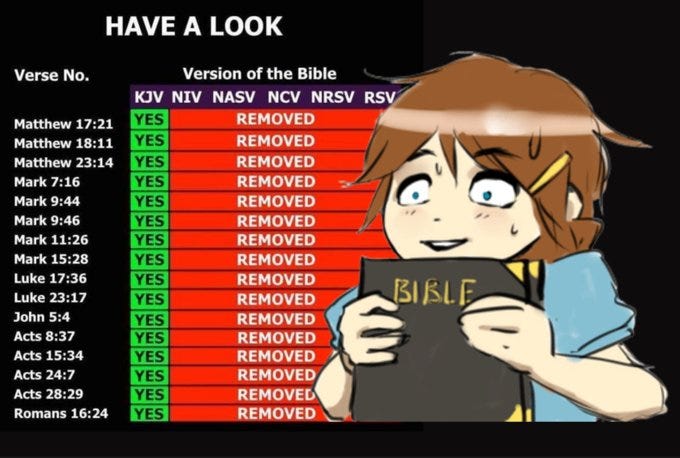
Other doctrines obscured in modern translations include the Trinity in 1 John 5:7-8, Christ's atonement in Colossians 1:14, the reality of Hell in Mark 9:44 and 9:46, and whether it is permitted to be angry at one's brother without cause in Matthew 5:22. These are not just side-notes, these things necessarily define Church doctrine, and can seriously affect the salvation of believers.
Even the same Bible translation will often update themselves. For example, the ESV had always translated Genesis 3:16 as "your desire shall be for your husband", later, they changed it to "your desire shall be contrary to your husband", which fundamentally alters the biblical theology of marriage. In the NIV 1984, Jesus says "the kingdom of God is within you." In the NIV 2011, it was changed to "in your midst". The NIV updated three times, the NASB three times also, the ESV four times, etc.
These alterations make sense when we consider that according to 17 U.S. Code § 103, a publisher cannot copyright a derivative text unless it is considered a "nontrivial expressive variation" of the original work. To protect profits, the mega-corporations that own the rights to Bible translations like the NIV must present something "different" to its predecessors, even if it changes the meaning of verses. Furthermore, the NIV is owned and published by Zondervan, the largest Bible publisher on earth. Zondervan is a subsidiary of the Big Five publisher, HarperCollins, which is itself owned by News Corp, owned by the fanatical Zionist Rupert Murdoch, whose vast media empire propagates Zionism across the globe. This is who your money goes to when you buy a modern Bible translation.
A possible counter argument would be to simply look at the original Greek/Hebrew texts to have the objective measure of reformation needed. For one, most people do not understand Greek or Hebrew, and thus have little authority to define doctrine according to it; and second of all, even people that have studied Greek and Hebrew their whole lives come to different conclusions on what the true meaning of certain verses are; which is why we have different translations in the first place. Furthermore, if we restricted biblical interpretation to academics, we would be reverting to the same Roman Catholic system the Protestant Reformation abolished.
The best and most effective way to establish clear and sound doctrine within the Church is to use solely one English Bible translation. So why is KJV the best? The KJV is the traditional Bible that was one of the most important things that arose from the Protestant reformation as a whole, it unified the English speaking church, was the main translation behind global missionary work that converted millions, it redefined the English language and introduced hundreds of idioms still used today, and most importantly, it is the oldest English Bible translation based on the original Greek and Hebrew manuscripts that remains functionally unchanged today. 99.5% of the alleged "changes" in the KJV only change 17th century spelling, the rest being word changes (such as "burnt" to "burned"). The last major change was in 1769, compared to modern translations, which change every 10 to 15 years.
If you are a proponent of the idea that any Bible will do, ask yourself this: Has God's word revealed through the prophets ever been fully revealed to the English speaking world? If so, then in what respect are constantly changing, contradictory Bibles superior to the KJV? If not, then why did God choose to allow for a Christian population who spread His message worldwide to never have received the full understanding of His word present in the Critical Text, which diminishes the divinity of Christ and several other important doctrine, considering that God promised to preserve His word in Psalm 12:6-7 and Matthew 24:35.
When one begins to tinker with the Scripture, Satan easily inserts himself into the text and subverts the Word of God from within.
Comments
Displaying 0 of 0 comments ( View all | Add Comment )