


On the surface, it's a fantasy story: a teenager has to go through a maze to rescue her little brother, who was kidnapped by the Goblin King. However, beyond all the fantasy, there's a story about adolescence, the desire to escape reality, and the moment we realize that growing up also means giving up certain fantasies.
Sarah starts the movie by taking refuge in books, theater, and her imagination. She's upset with her family, feels like no one understands her, and daydreams about a world where everything revolves around her. When, in a moment of frustration, she wishes the goblins would take her brother Toby, that wish comes true.
That's the starting point of a story that, more than a physical journey, works as an emotional one.
The labyrinth is not just a place full of traps. It's a representation of the challenges of growing up. Each trial forces Sarah to question her decisions, trust other people, and accept that the world doesn't always respond to her wishes. Slowly, she stops acting like a girl who wants to control reality through fantasy and starts taking responsibility for her actions.
By the time she finally reaches Jareth's castle, she is no longer the same person who started the journey.
The movie's set design is really well done and it's absolutely easy to associate with Labyrinth. The creatures have a strange, fantastic beauty. They aren't cute or perfect characters; they have imperfections and can even be unsettling.
The castle's architecture also deserves attention. Rooms where gravity stops making sense, impossible staircases, and spaces that defy any logic. It's as if the outside world reflects Sarah's mental state: the closer she gets to understanding who she is, the more confusing and surreal everything around her becomes.
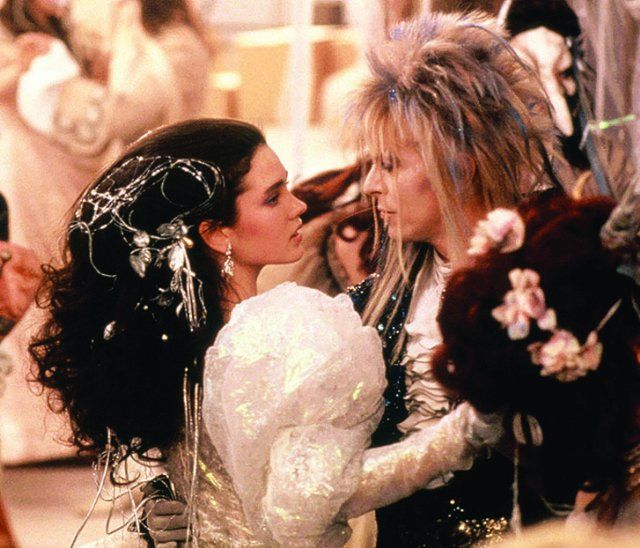
And then there's Jareth. David Bowie builds an absolutely magnetic character. His costume mixes aristocratic elegance with the extravagance of glam rock. He doesn't seem like a traditional villain; he seems like someone capable of turning any promise into a temptation.
Jareth never tries to overpower Sarah by force. What's interesting about Jareth is that, in reality, he almost never uses violence to get what he wants; he prefers to seduce. He offers her a world without responsibilities. A place where she will always be special, where everyone will admire her, and where she will never have to face the frustrations of the real world.
It's a very attractive offer. But also a deeply dangerous one. Because everything he offers comes at a price: giving up freedom. That's why Jareth works so well as an antagonist. He doesn't just represent evil; he represents the temptation to give up autonomy in exchange for comfort, idealization, and dependence.
this is one of my favorite dialogues so I definitely had to talk about this.
"I ask for so little. Just let me rule you, and you can have everything that you want. Just fear me, love me, do as I say, and I will be your slave."
These words contradict each other since how can someone be master and slave at the same time? The answer lies in the nature of power. Jareth can only be a dominant figure over Sarah if she agrees to submit to him. That is, he needs her consent, otherwise all that power disappears.
When he says he will be her slave, he inadvertently reveals his greatest weakness: he also depends on her. His identity as King of the Goblins exists only as long as Sarah continues to believe in him and grants him authority.
The phrase also accurately describes how many manipulative relationships work. It all starts with an apparently insignificant request.
"I ask for so little."
Then the conditions follow. What seems like a small concession ends up becoming an absolute surrender of one’s own will.
It’s no coincidence that Jareth mixes fear with love. They are two completely different emotions, but manipulators often confuse them to build emotionally dependent relationships.
"You have no power over me"
She doesn't defeat Jareth using magic, she doesn't beat him with a sword. She simply realizes that the power he held relied on her continuing to believe in him.
This ending reminds us that sometimes, the only way to get out of a maze is to understand that many of its walls existed because we kept believing in them.
10/10
What do you think?
Comments
Displaying 1 of 1 comments ( View all | Add Comment )
discmaan_
OMG, Labyrinth mentioned!! I absolutely love this movie, and as a huge David Bowie fan, reading your review made me so happy!!!
I really enjoyed your interpretation because you went far beyond the fantasy elements and talked about what the story is really trying to say. I especially loved your analysis of Jareth. It's so easy to see him as just a charismatic villain, but you're right, his power only exists because Sarah allows it to. I love how u connected it to manipulation and emotional dependence. It makes the ending feel even more powerful
And of course... David Bowie is absolutely mesmerizing here. His performance, the music, the costumes, his presence, he turns Jareth into one of the most unforgettable fantasy characters ever put on screen. Every scene he's in feels magical
This was such a pleasure to read. It's always exciting to find someone else who appreciates Labyrinth not just as a nostalgic fantasy film, but as a story with so much symbolism and emotional depth. Amazing review<33