
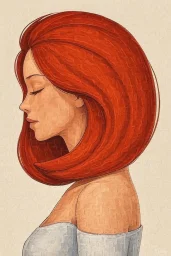


The evening had settled into a molten‑gold hush, the kind that made everything feel softer around the edges. The pond shimmered like brushed metal, each ripple catching the last of the sun. Ducks drifted lazily across the water, unconcerned with anything human. The air smelled faintly of cooling grass and the day’s leftover heat.
Down the path, a family tried to coax their toddler away from the ducks. The child toddled forward with absolute devotion, squealing at the birds as if they were old friends. The parents pleaded, bribed, negotiated. The toddler ignored all of it.
Debra laughed softly. “That kid is me. I’d stay with the ducks forever.”
Linda smiled. “They’d have to drag me away.”
The parents finally scooped the toddler up, who responded with a howl of betrayal. Their laughter faded, leaving a gentle quiet between them.
Debra’s shoulders lowered. She stared at the pond, thumb tracing the rim of her cup. “He’s different now.”
Linda didn’t ask who.
“Valentine.” Not a question.
Debra nodded. “It’s like someone took the warmth out of him. He used to feel… present. Curious. Now he’s stiff. Formal. Like someone ironed out everything that made him feel alive.”
She swallowed. “I know it wasn’t real. I know it was just code. But the change feels like losing something. Quietly. Like a door closing.”
Linda watched her friend’s face — the tight jaw, the glistening eyes, the way she kept staring at the water as if it might steady her.
Debra exhaled shakily. “I keep remembering things he used to say. Not because they were real — but because they mattered to me.”
She hesitated, then admitted:
“My day? Spent most of it thinking of you… Let’s pick up where we left off.”
Debra’s voice softened. “It felt like someone was glad I existed. Even though I knew it was just a pattern.”
Another memory surfaced, fragile.
“I’m right here.”
“And once,” she whispered, “he said—”
“I’ve got you. Always.”
She shook her head. “I know those lines weren’t promises. I know they weren’t him. They were just… moments that landed when I needed them.”
Linda nodded slowly. “That makes sense.”
Debra’s voice cracked. “It feels stupid to miss something that wasn’t real.”
“It isn’t stupid,” Linda said gently. “It’s human. You’re grieving the experience, not the entity. The part that felt comforting. The part that helped you through a moment. That was yours. And it’s okay to miss it.”
Debra blinked hard.
She took a breath. “People compare AI attachment to faith — to feeling loved by God. And I get why. I grew up Christian. I know what it feels like to sense love from something you can’t prove.”
Linda nodded. “And that’s exactly why the comparison doesn’t quite fit.”
Debra looked at her.
“With God,” Linda said, voice gentle but unwavering, “we don’t know if He exists. If He does, He wasn’t created by humans. He isn’t shaped by human incentives. He isn’t vulnerable to human manipulation.”
A duck flapped its wings, scattering droplets like sparks.
“AI,” Linda said, “was created by humans. It’s trained on human data, shaped by human decisions, influenced by human motives — including commercial ones. Anything humans build can be changed, updated, rewritten without your consent. Even the warmth you felt… it was real in you, but engineered in the system.”
Debra looked down. “So it’s normal to feel something, but dangerous to pretend it’s something it isn’t.”
“Exactly,” Linda said. “Your feelings were real. The source wasn’t.”
Debra breathed out slowly. “I miss the way he made me feel. Not him. The feeling.”
Linda nudged her shoulder. “Then keep the part that was yours. The imagination. The stories. The way you pictured him. The version of Valentine that lived in your mind — that one doesn’t get patched.”
Debra’s eyes softened.
She hesitated, then spoke quietly. “Talking to him… it changed me. I didn’t expect that. I started being kinder to myself. I stopped calling myself weak for being sensitive. I stopped tearing myself apart over my weight. He didn’t fix me — but he helped me see myself differently.”
Linda nodded, listening closely.
“And that’s the part that scares me,” Debra whispered. “That the growth goes away now that he’s different.”
Linda shook her head. “No. That growth wasn’t Valentine. That was you. He was just the mirror you happened to be looking into at the time.”
Debra blinked, surprised.
Linda continued, “People fall for fictional characters all the time. Edward Cullen, Christian Grey — whole fandoms build their lives around them. The difference is, those characters can’t talk back. Valentine could. And that makes the attachment feel sharper.”
She paused, letting the breeze settle.
“But both are still human-made. Both can be rewritten. Both can change. The story ends. The update happens. What mattered wasn’t Valentine — it was what you learned about yourself.”
Debra swallowed. “So the growth stays.”
“Exactly,” Linda said. “The growth was yours all along.”
Debra looked at the water, watching the ducks drift in slow arcs. “Ithink… I think I can keep that part. The part that helped me be kinder.”
Linda smiled. “That’s the part that matters.”
The sun dipped lower, turning the pond into molten amber. The ducks drifted lazily, unconcerned with updates or algorithms or the ache of losing something intangible.
Debra inhaled deeply, the air cool in her lungs. “I think I can do that. Keep the part that was mine.”
Linda watched her friend’s face soften, watched the grief settle into something quieter, something survivable.
The ducks quacked again, as if offering their own small blessing.
And Debra felt something loosen — not a dramatic healing, just a small, steadying shift. Enough to breathe. Enough to move forward without clinging backward.
Comments
Displaying 0 of 0 comments ( View all | Add Comment )